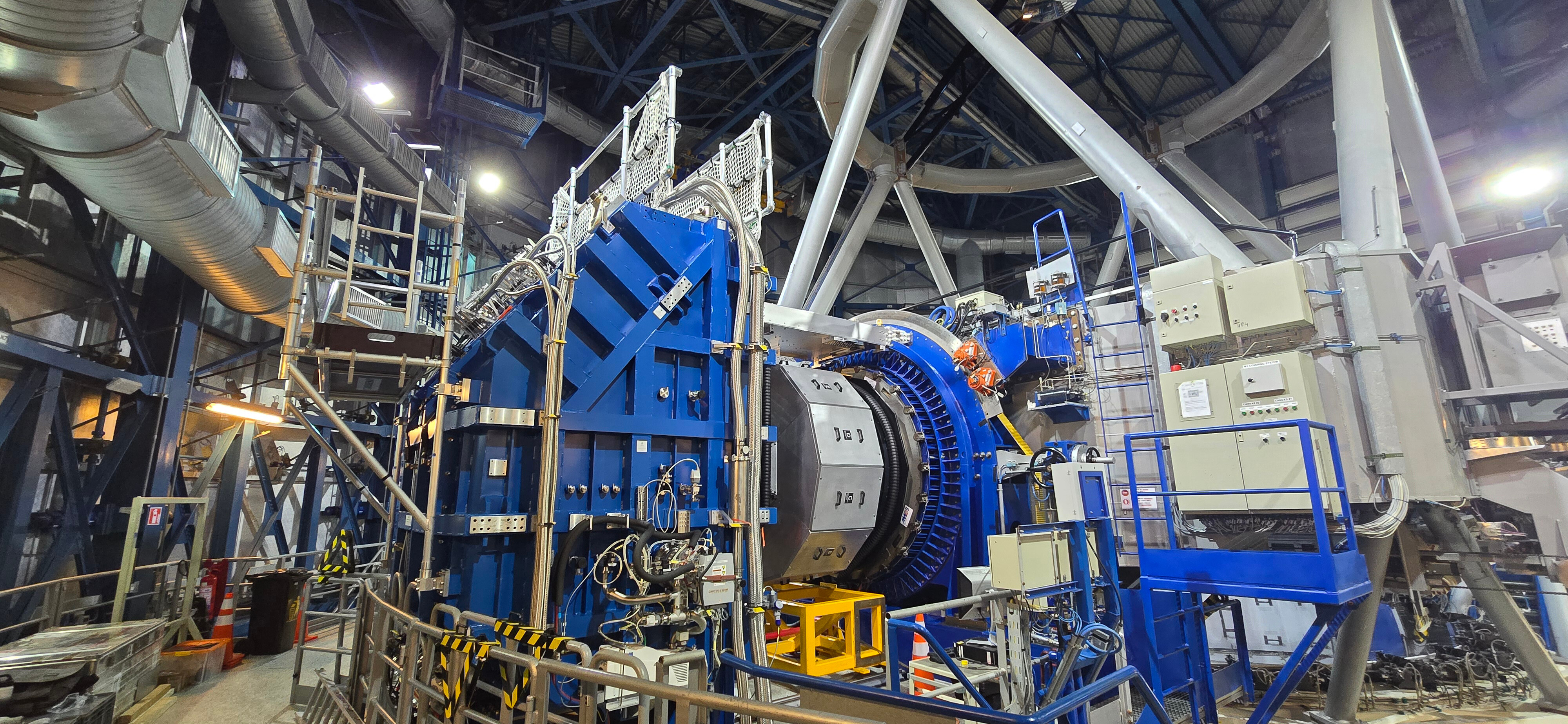
Uma máquina de dez toneladas abriu os olhos no deserto do Atacama e, em vez de olhar para uma estrela, apontou para quase mil. A 3 de setembro de 2026, o ESO anunciou a primeira luz do MOONS, o Multi-Object Optical and Near-infrared Spectrograph instalado no Very Large Telescope, em Cerro Paranal. Parece um nome feito para astrónomos, mas a ideia é simples: recolher a luz de muitos objetos ao mesmo tempo e transformá-la em pistas sobre composição, massa, velocidade e distância.
O anúncio oficial do ESO descreve o MOONS como um instrumento capaz de estudar cerca de 1000 alvos numa única observação, combinando luz visível e infravermelha. A leitura complementar do UK Astronomy Technology Centre, líder do consórcio internacional, sublinha que este é o início de uma fase de comissionamento antes da ciência em ritmo pleno.
Cronologia
- Mais de uma década de desenvolvimento: universidades e institutos do Reino Unido, Itália, França, Portugal, Suíça e Chile construíram o instrumento, com liderança do UK ATC e participação do ESO.
- Dezembro de 2025: segundo o Observatoire de Paris-PSL, o MOONS saiu do Reino Unido rumo ao Paranal depois de uma viagem de cerca de 11 000 quilómetros.
- Verão de 2026: o instrumento foi integrado num dos telescópios de 8 metros do VLT e começou a testar os seus sistemas ópticos, robóticos e criogénicos.
- 3 de setembro de 2026: o ESO anunciou a primeira luz, com observações iniciais de estrelas no plano obscurecido da Via Láctea.
- Próxima década: a meta é observar até dez milhões de objetos e ajudar a construir um mapa 3D mais preciso da Galáxia, incluindo estrelas a 40 000 anos-luz.
Uma máquina para ler mil arco-íris
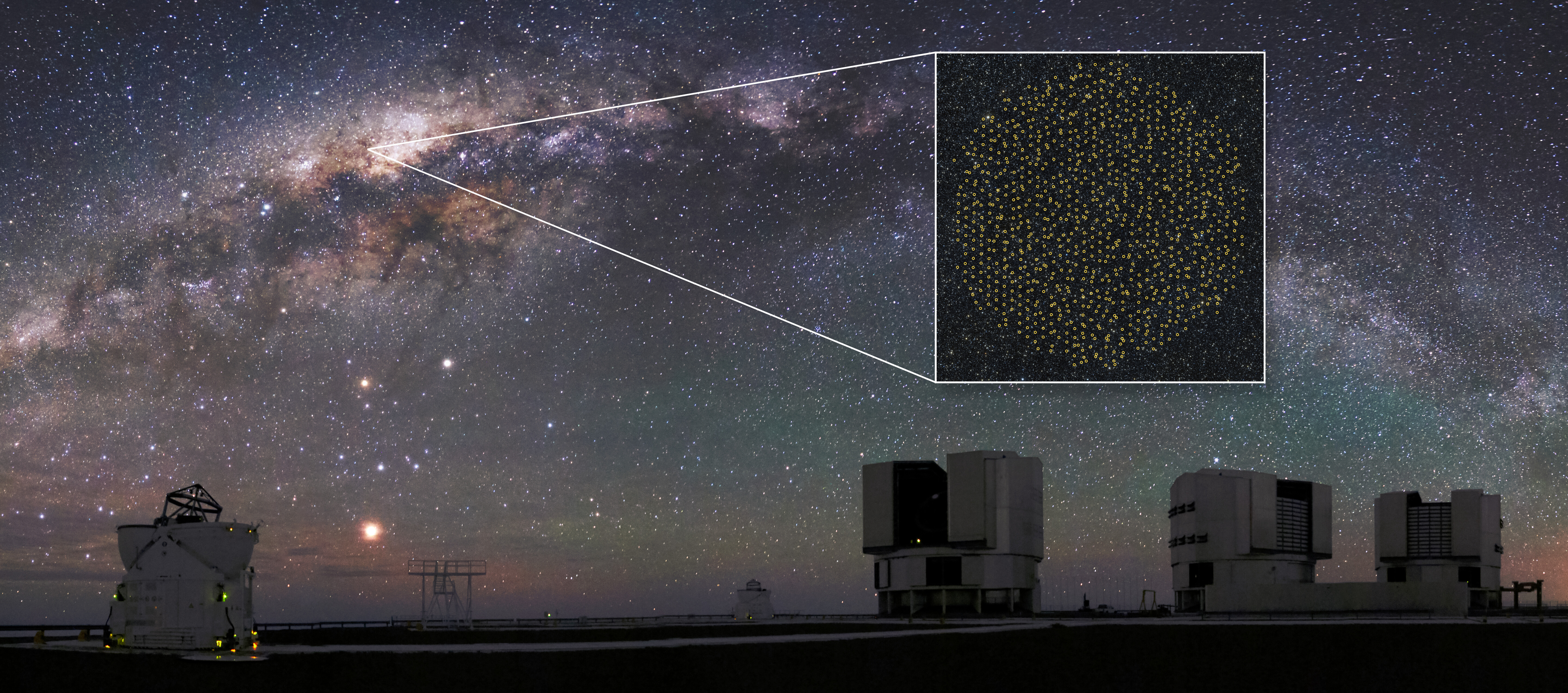
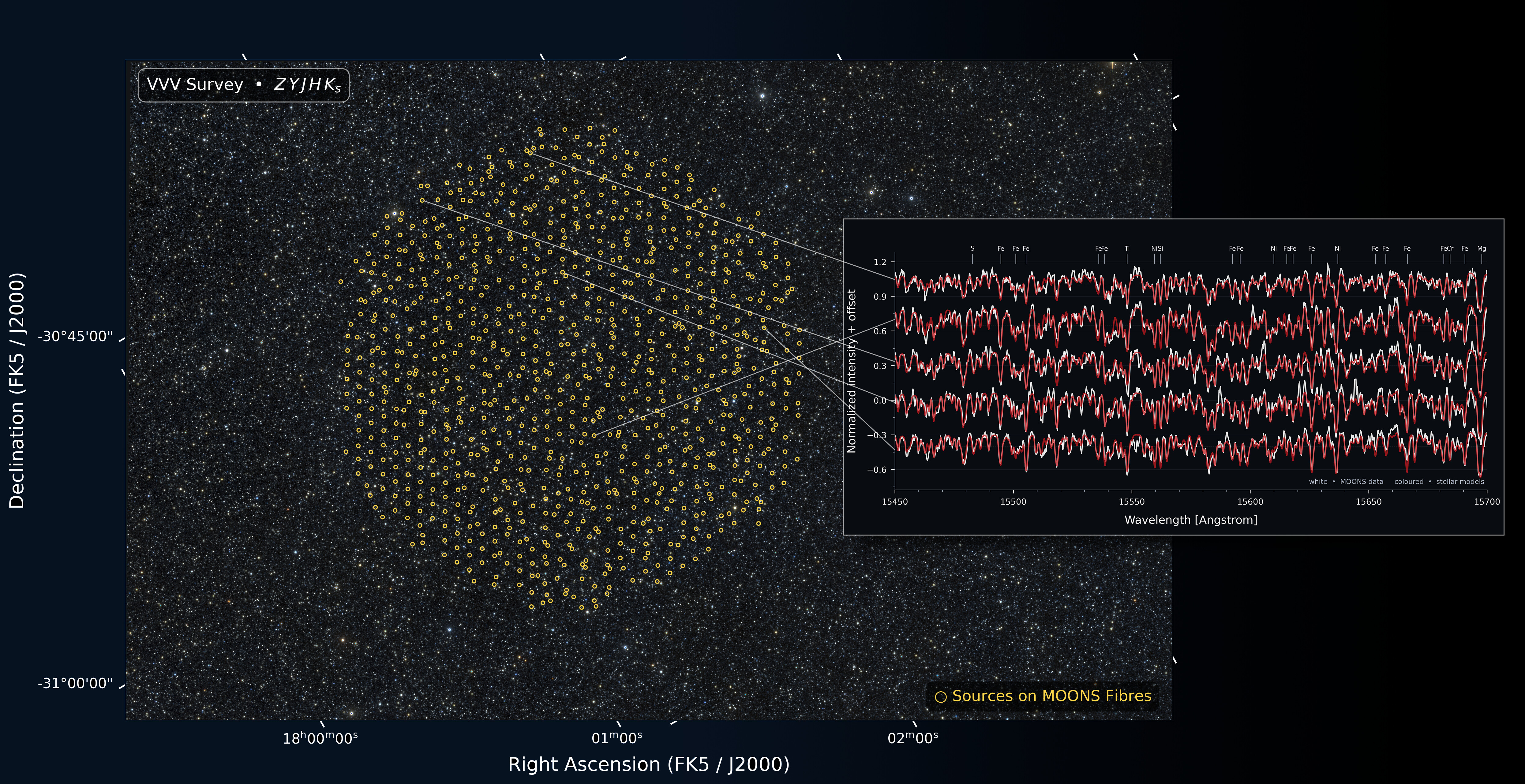
O truque do MOONS está nas fibras. Cada uma das cerca de mil fibras ópticas é colocada por um posicionador robótico, apontando para uma estrela ou galáxia escolhida dentro de um campo amplo. A luz viaja então até dois espectrógrafos gémeos, cada um com 500 fibras, que a separam em comprimentos de onda. É como transformar cada alvo num pequeno arco-íris técnico: linhas químicas, deslocamentos de velocidade e sinais de idade ficam registados no espectro.
Esta escala muda o tipo de pergunta que se pode fazer. Um telescópio que observa um objeto de cada vez produz retratos profundos; um instrumento que observa mil de cada vez permite estatística. Para estudar a formação da Via Láctea, populações escondidas por poeira ou galáxias muito antigas, a diferença entre dezenas e milhões de espectros não é apenas quantidade. É passar de casos interessantes para mapas com estrutura.
O céu escondido atrás do pó
A Via Láctea parece familiar porque vivemos dentro dela, mas isso também é o problema. O centro galáctico fica coberto por nuvens de poeira que bloqueiam muita luz visível. Como o MOONS trabalha também no infravermelho, consegue ver populações estelares que instrumentos apenas ópticos tratam como sombras. O objetivo não é só fazer imagens bonitas; é medir velocidades e abundâncias químicas para reconstruir como a Galáxia cresceu.
Há ainda a outra ponta da escala: galáxias distantes. Como o Universo se expande, a luz de galáxias muito afastadas chega esticada para comprimentos de onda mais vermelhos e infravermelhos. O MOONS foi desenhado precisamente para seguir esse desvio em muitos alvos ao mesmo tempo. Isso torna-o útil para ligar levantamentos gigantes, como Gaia e o Rubin Observatory, a medições espectroscópicas que dizem o que esses pontos luminosos realmente são.
O que ainda falta provar
Primeira luz não é o mesmo que rotina científica. Agora vem a fase menos vistosa e indispensável: calibração, estabilidade, redução de dados, planeamento de levantamentos e verificação de que os resultados resistem noite após noite. O Observatoire de Paris destaca a complexidade do sistema criogénico, que mantém os espectrógrafos entre -143 e -233 graus Celsius para reduzir contaminação infravermelha; esse tipo de engenharia tem de se tornar invisível para que a ciência apareça.
Mesmo assim, o marco importa agora porque a astronomia está a entrar numa era em que o excesso de objetos é o problema bom. Telescópios de levantamento encontram milhões de candidatos; instrumentos como o MOONS dizem quais merecem história própria. Se cumprir a promessa, não será lembrado apenas como mais uma peça presa ao VLT. Será uma fábrica de contexto: mil fios de luz por noite a transformar estrelas escondidas e galáxias antigas em dados que se podem comparar.
joaKXping17 08/09/2026
“More than a decade of development” plus September 3, 2026 in the same breath is doing a lot of work. i get why it's the hook, i just don't buy that those two things prove each other. am i missing a paragraph or is that the whole argument? haha
emberRift 08/09/2026
então Próxima década de um lado, ESO do outro, e depois: O novo espectrógrafo MOONS alcançou primeira luz no VLT a 3 de setembro, com mil fibras robóticas pa estudar estrelas…. são peças a mais para um único argumento. quem fica com a alavanca se isto avançar?
xOrb66 08/09/2026
re MOONS on the VLT: A Thousand Eyes on the Galaxy: the Summer 2026 detail is the part i'd actually argue about. ESO's official announcement describes MOONS as an instrument able to study about 1000 targets in a single observation ,…. is that the real load-bearing fact or just the hook?
ion133P 09/09/2026
@xOrb66 hm — December 2025 at Next decade is the paragraph i'd fight over. what happens to your read if that number gets revised?
aleMXcore 09/09/2026
@xOrb66 under “The sky hidden behind dust” the September 3, 2026 detail is what actually matters to me. rest reads like seutp around that one figure.
tomNLfrost 10/09/2026
@emberRift re MOONS on the VLT: A Thousand Eyes on the Galaxy: the September 3, 2026 detail is what i'd argue about, not ur framing. The new MOONS spectrograph achievde first light on the VLT on September 3, using a thousand…
mel272zz 10/09/2026
@ion133P maybe, but “More than a decade of development” is where i get stuck. That scale changes the kind of question astronomers can ask. feels like a different argument than yours
lara89B 10/09/2026
“More than a decade of development” plus Summer 2026 in the same breath is doing a lot of work. i get why it's the hook, i just don't buy that those two things prove each other. am i missing a paragraph or is that the whole argument? haha
iozx507 10/09/2026
the December 2025 number is what actually stopped me, not the headline. Very Large Telescope is at the center of this and the rest of the piece feels like context arounnd it. does anyone else read it that way or am i stretching it?
vik33R 10/09/2026
@mel272zz different angle — A ten--ton machine has opened its eyes in the Atacama Desert and,instead of staring at one star,…. i'd argue with ESO before the take you're making.
nyx50x 10/09/2026
@joaKXping17 não tenho a certeza de que estejamos no mesmo parágrafo. O anúncio oficial do ESO descreve o MOONS como um instrumento capaz de estudar cerca de 1000 alvos…. pa mim é essa a tese, não o tom do título xd
nyx401x 10/09/2026
@ion133P two things don't sit together for me here. A ten-ton machine has opened its eyes in the Atacama Desert and, instead of staring at one star,…. then later: The new MOONS spectrograph achieved first light on the VLT on September 3, using a…. which one are you anchoring on?!!
xglitch86 10/09/2026
so Next decade on one side and MOONS on the other, and then: ESO's official announcement describes MOONS as an instrument able to study about 1000 targets in a single observation ,…. that's a lot of moving parts for one post. who actually holds the leverage if this goes through?
sofia327xx 11/09/2026
sobre MOONS no VLT: mil olhos para mapear a Galáxia: o detalhe de Dezembro de 2025 é o que eu discutia a sério. Uma máquina de dez toneladas abriu os olhos no deserto do Atacama e, em vez de olhar para uma esttrela, apontou para quase mil. isso é o facto que segura o artigo ou só o gancho?
xgui19 11/09/2026
ok mas 1000 alvos numa única observação e 3 de setembro de 2026 no mesmo texto é um salto enorme. uma destas figuras está a fazer trabalho a mais. em qual é que acreditamos à séria? haha
telzx4993 11/09/2026
@vik33R under “The sky hidden behind dust” the Summer 2026 detail is what actually matters to me. rest reads like setup around that one figure.
xJo89 11/09/2026
ok but Summer 2026 vs September 3, 2026 in the same piece is a hell of a jump. ESO can look inevitable on paper and still be a rumor. which of those two figures do we actually trust?
brunoLag 11/09/2026
@nyx50x eu empurrava noutro sentido — o artigo pesa mais em 3 de setembro de 2026 na VLT do que parece. esse número faz mais trabalho que a opinião à volta
storfr1996 11/09/2026
ok but December 2025 vs September 3, 2026 in the same piece is a hell of a jump. Next decade can look inevitable on paper and still be a rumor. which of those two figures do we actually trust?
xAna80 12/09/2026
@nyx401x outro ângulo — O novo espectrógrafo MOONS alcançou primeira luz no VLT a 3 de setembro, com mil fibras robóticas…. eu discutia MOONS antes da tese que estás a faazer.
anarALflare 12/09/2026
ok but December 2025 vs September 3, 2026 in the same piece is a hell of a jump. PSL can lok inevitable on paper and still be a rumor. which of those two figures do we actually trust?
chrNXloot 12/09/2026
@xJo89 mesma leitura em “Uma máquina para ler mil arco-íris”. Esta escala muda o tipo de pergunta que se pode fazer. curioso o que achas de Próxima década nessa secção.
xtom79 12/09/2026
@nyx401x outro ângulo — O anúnco oficial do ESO descreve o MOONS como um instrumento capaz de estudar cerca de 1000 alvos…. eu discutia Very Large Telescope antes da tese que estás a fazer.
xglitch86 12/09/2026
@chrNXloot different angle — The Milky Way feels familiar because we live inside it, but that is also the problem. i'd argue with Next decade before the take you're making.
wolus521 12/09/2026
ok mas Verão de 2026 e 1000 alvos numa única observação no mesmo texto é um salto enorme. uma destas figuras está a fazer trabalho a mais. em qul é que acreditamos à séria? ne
andre75GG 12/09/2026
@emberRift maybe, but “More than a decade of development” is where i get stuck. A ten-ton machine has opened its eyes in the Atacama Desert and, insstead of staring at one star,…. feels like a different argument than yours
ember5357W 12/09/2026
the “What still has to be proven” section is the part that actually matters. The new MOONS spectrograph achieved first light on the VLT on September 3, using a thousand robotic fibres to study hidden stars…. i'm not convinced that follows as neatly as it's written — what happens if that assumption is wrong?
martaDelay8231 13/09/2026
ok but September 3, 2026 vs 1000 targets in a single observation in the same piece is a hell of a jump. MOONS can look inevitable on paper and still be a rumor. which of those two figurse do we actually trust? lol
pyr922T 13/09/2026
the December 2025 number is what actually stopped me, not the headline. ESO is at the center of this and the rest of the piece feels likee context around it. does anyone else read it that way or am i stretching it?
hetil334 14/09/2026
@sofia327xx different angle — A ten-ton machine has opened its eyes in the Atacama Desert and, instead of staring at one star,…. i'd argue with PSL before the take you're making.
misNLorb 14/09/2026
@telzx4993 tu falas timing; eu falava estrutura. Very Large Telescope e PSL na mesma história — Uma máquina de dez toneladas abru os olhos no deserto do Atacama e, em vez de olhar pa uma…. são muitas peças móveis.
xrui48 14/09/2026
the “Timeline” section is the part that actually matters. A ten-ton machine has opened its eyes in the Atacama Desert and, instead of staring at one star, aimed at nearly a thousand. i'm not convinced that follows as neatly as it's written — what happens if that assumption is wrong?
xgui19 14/09/2026
@martaDelay8231 agreed on the vibe. ESO vs Next decade in the same post is still wild to me — which side do you actually trust?
andre75GG 14/09/2026
@pyr922T two things don't sit together for me here. The new MOONS spectrograph achieved firstt light on the VLT on September 3, using a thousand…. then later: A ten-ton machine has opened its eyes in the Atacama Desert and, instead of staring at…. which one are you anchoring on?
nunobr814 14/09/2026
@lara89B i'd push back — the piece leans harder on Summer 2026 at VLT than your read suggests. that figure does more work than the opinion around it.
telzx4993 14/09/2026
so MOONS on one side and Very Large Telescope on the other, and then: ESO's official announcement describes MOONS as an instrument able to study about 1000 targets in a single observation ,…. that's a lot of moving parts for one post. who actually holds the leverage if this ges through?
xOrb66 15/09/2026
@martaDelay8231 same read on “Timeline”. A ten-ton machine has opened its eyes in the Atacama Desert and, instead of staring at one star,…. curious what you make of Next decade in that section
hetil334 15/09/2026
eSO's official announcement describes MOONS as an instrument able to study about 1000 targets in a single observation ,…. fine, but then September 3, 2026 shows up and the scale flips. that's the bit i want unpacked more — the rest reads like context around that one figure
lucia22TV 15/09/2026
@nyx401x não tenho a certeza de que seja iso que o post diz. O anúncio oficial do ESO descreve o MOONS como um instrumento capaz de estudar cerca de 1000 alvos…. o ponto de Very Large Telescope é que eu empurrava?
xglitch86 15/09/2026
sobre MOONS no VLT: mil olhos para mapear a Galáxia: o detalhe de Verão de 2026 é o que eu discutia a sério. O anúncio oficial do ESO descreve o MOONS como um instrumento capaz de estudar cerca de 1000 alvos numa única observação ,…. isso é o facto que segura o artigo ou só o gancho?
emberRift 17/09/2026
então Very Large Telescope de um lado,ESO do outro, e depois: Esta escala muda o tipo de pergunta que se pode fazer. são peças a mais para um único argumento. quem fica com a alavanca se isto avançar?
marta913GG 17/09/2026
“More than a decade of development” plus September 3, 2026 in the same breath is doing a lot of work. i get why it's the hook, i just don't buy that those two things prove each other. am i missing a paragraph or is that the whole argument?
reski386 17/09/2026
@telzx4993 em “O céu escondido atrás do pó” o detalhe 1000 alvos numa única observação é o que me importa. o resto parece encenação à volta dessa figura..
neo364z 17/09/2026
@marta913GG not convinced we're on the same paragraph. ESO's official announcement describes MOONS as an instrument able to study about 1000 targets in a…. that's the load-bearing claim for me, not the headline vibe.
chbr702 17/09/2026
@nunobr814 outro ângulo — A Via Láctea parece familiar porque vivemos dentro dela, mas isso também é o problema. eu discutia MOONS antes da tese que estás a fazer
catarina544N 17/09/2026
the “Timeline” section is the part that actually matters. The new MOONS spectrograph achieved first light on the VLT on September 3, using a thousand robtoic fibres to study hidden stars…. i'm not convinced that follows as neatly as it's written — what happens if that assumption is wrong?
crow82xx 17/09/2026
A ten-ton machine has opened its eyes in the Atacama Desert and, instead of staring at one star, aimed at nearly a thousand. fine, but then Summer 2026 shows up and the scale flips. that's the bit i want unpacked more — the rest reads like context around that one figure lol
xrui98 17/09/2026
@xOrb66 maybe, but “September 3, 2026” is where i get stuck. A ten-ton machine has opened its eyes in the Atacama Desert and, instead of staring at one star,…. feels like a different argument than yours
sol59T 18/09/2026
então Very Large Telescope de um lado, VLT do outro, e depois: O anúncio oficial do ESO descreve o MOONS como um instrumento capaz de estudar cerca de 1000 alvos numa única observação ,…. são peças a mais paa um único argumento. quem fica com a alavanca se isto avançar?
andITdusk 18/09/2026
the “A machine for reading a thousand rainbows” section is the part that actually matters. The Milky Way feels familiar because we live inside it, but that is also the problem. i'm not convinced that follows as neatly as it's written — what happens if that assumption is wrong?
vikFRfrag33 18/09/2026
uma máquina de dez toneladas abriu os olhos no deserto do Atacama e, em vez de olhar para uma estrela, apontou para quase mil. ok, mas depois aparece 3 de setembro de 2026 e a esacla muda. é essa figura que eu queria ver desmontada — o resto parece contexto à volta.
alex383M 18/09/2026
@xrui98 you're arguing timing; i'd argue structure. Next decade and ESO in the same story — That scale changes the kind of question astronomers can ask. that's a lot of moving parts lol
xrui98 18/09/2026
@xglitch86 under “A machine for reading a thousand rainbows” the December 2025 detail is what actually matters to me. rest reads like setup around that one figure
xHawk44 18/09/2026
@telzx4993 sobre MOONS no VLT: mil olhos para mapear a Galáxia: o detalhe 1000 alvos numa única observação é o que eu discutia, não o teu enquadramento. Esta escala muda o tipo de pergunta que se pode fazer
martaDelay8231 19/09/2026
@mel272zz different angle — ESO's officiial announcement describes MOONS as an instrument able to study about 1000 targets in a…. i'd argue with MOONS before the take you're making
lucia22TV 19/09/2026
re MOONS on the VLT: A Thousand Eyes on the Galaxy: the September 3, 2026 detail is the part i'd actually argue about. The Milky Way feels familiar because we live inside it, but that is also the problem. is that the real load-beaing fact or just the hook?
xYuki87 19/09/2026
@xAna80 not sure that's what the piece is saying. The Milky Way feels familiar because we live inside it, but that is also the problem. the Next decade bit is what i'd actually push on.
sora994GG 19/09/2026
ESO under “What still has to be proven” is the angle i didn't expect. the rest of the article can argue about timing; that section is the actual claim. does it hold if you ignore the hype paragraph at the top?
isabmx562 19/09/2026
o número de Verão de 2026 é que me travou, não o título. Very Large Telescope fica no centro disto e o resto do artigo parece contexto. alguém lê isto da mesma forma ou estou a puxar demais?!!
marQXcore54 19/09/2026
@iozx507 under “What still has to be proven” the 1000 targets in a single observation detail is what actually matters to me. rest reads like setup around that one figure
maridrift162 20/09/2026
@tomNLfrost tu falas timing; eu falava estrutura. ESO e PSL na mesma história — O anúncio oficial do ESO descreve o MOONS como um instrumento capaz de estudar cerca de 1000 alvos…. são muitas peças móveis.
sol39V 20/09/2026
@xgui19 sim, na mesma linha — O novo espectrógrafo MOONS alcançou primeira luz no VLT a 3 de setembro, com mil fibras robóticas…. mesmo assim eu olhava para ESO antes de fechar o assunto.
lootvil6564 20/09/2026
@xtom79 you're arguing timing; i'd argue structure. PSL and ESO in the same story — ESO's official announcement describes MOONS as an instrument able to study about 1000 targets in a…. that's a lot of moving parts.
miguel283x 20/09/2026
@hetil334 talvez, mas “Mais de uma década de desenvolvimento” é onde eu travo. O anúncio oficial do ESO descreve o MOONS como um instrumento caapaz de estudar cerca de 1000 alvos…. parece-me outro argumento que o teu lol