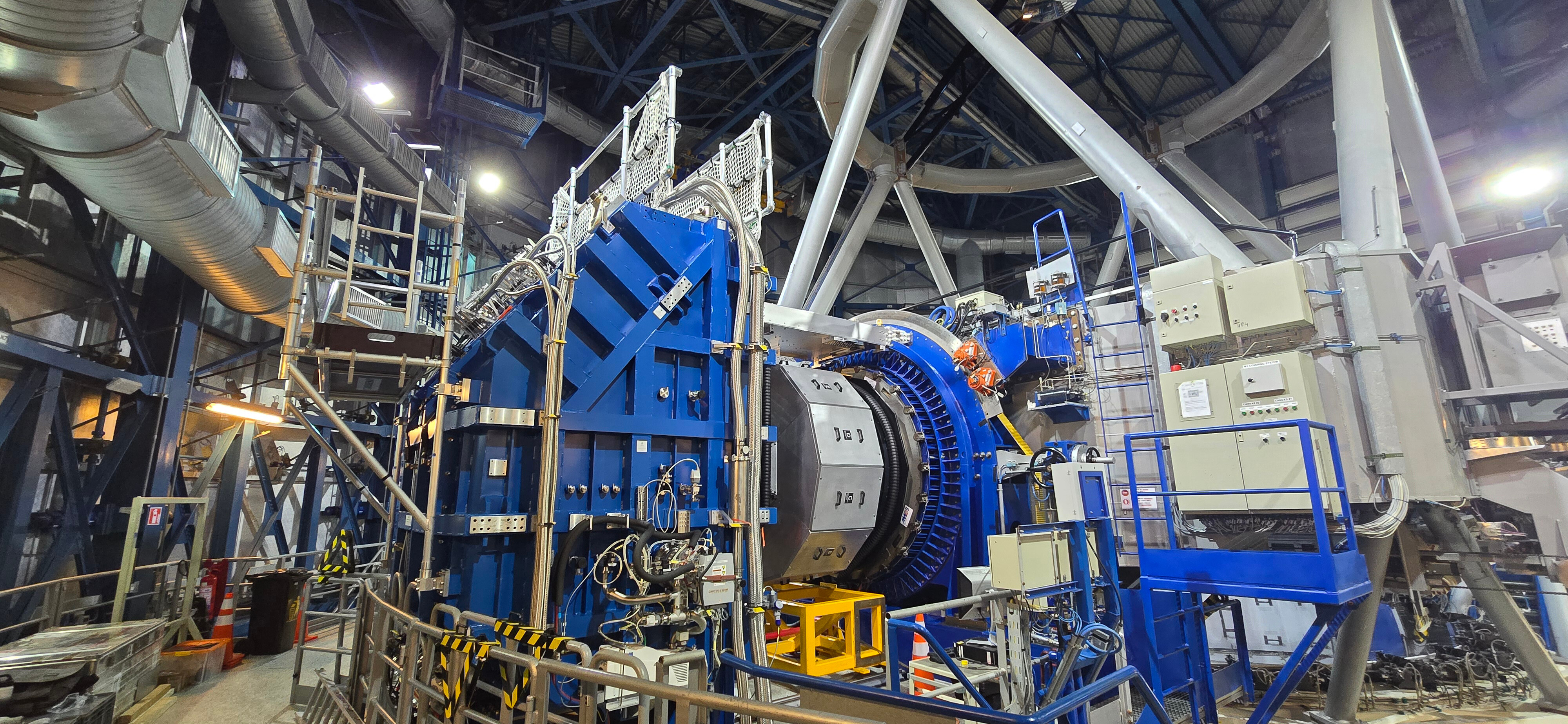
A ten-ton machine has opened its eyes in the Atacama Desert and, instead of staring at one star, aimed at nearly a thousand. On September 3, 2026, ESO announced first light for MOONS, the Multi-Object Optical and Near-infrared Spectrograph installed on the Very Large Telescope at Cerro Paranal. The name sounds built for astronomers, but the idea is direct: collect light from many objects at once and turn it into clues about composition, mass, velocity, and distance.
ESO's official announcement describes MOONS as an instrument able to study about 1000 targets in a single observation, combining visible and infrared light. The complementary note from the UK Astronomy Technology Centre, which led the international consortium, stresses that this is the beginning of commissioning before full scientific operations.
Timeline
- More than a decade of development: universities and institutes in the UK, Italy, France, Portugal, Switzerland, and Chile built the instrument, led by UK ATC with ESO participation.
- December 2025: according to the Observatoire de Paris-PSL, MOONS left the UK for Paranal after a journey of roughly 11,000 kilometres.
- Summer 2026: the instrument was integrated with one of the VLT's 8-metre telescopes and began testing its optical, robotic, and cryogenic systems.
- September 3, 2026: ESO announced first light, with initial observations of stars in the obscured plane of the Milky Way.
- Next decade: the goal is to observe up to ten million objects and help build a more precise 3D map of the Galaxy, including stars 40,000 light-years away.
A machine for reading a thousand rainbows
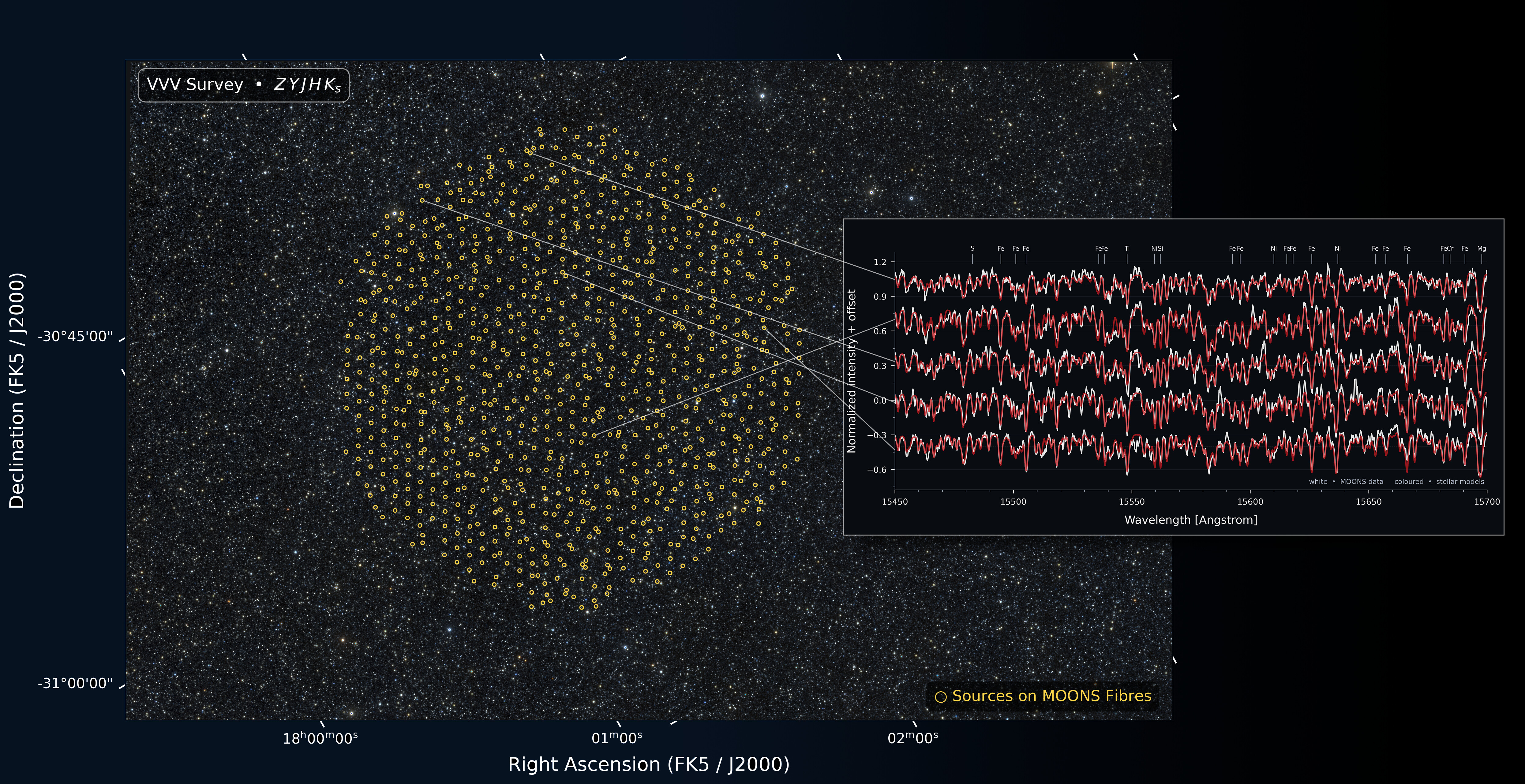
MOONS' trick is in its fibres. Each of its roughly one thousand optical fibres is placed by a robotic positioner, pointing at a selected star or galaxy across a wide field. The light then travels into two twin spectrographs, each handling 500 fibres, which split it by wavelength. It is like turning every target into a small technical rainbow: chemical lines, velocity shifts, and age clues are recorded in the spectrum.
That scale changes the kind of question astronomers can ask. A telescope observing one object at a time produces deep portraits; an instrument observing a thousand at a time enables statistics. For studying the Milky Way's formation, dust-hidden populations, or very ancient galaxies, the difference between dozens and millions of spectra is not only quantity. It is the move from interesting cases to structured maps.
The sky hidden behind dust
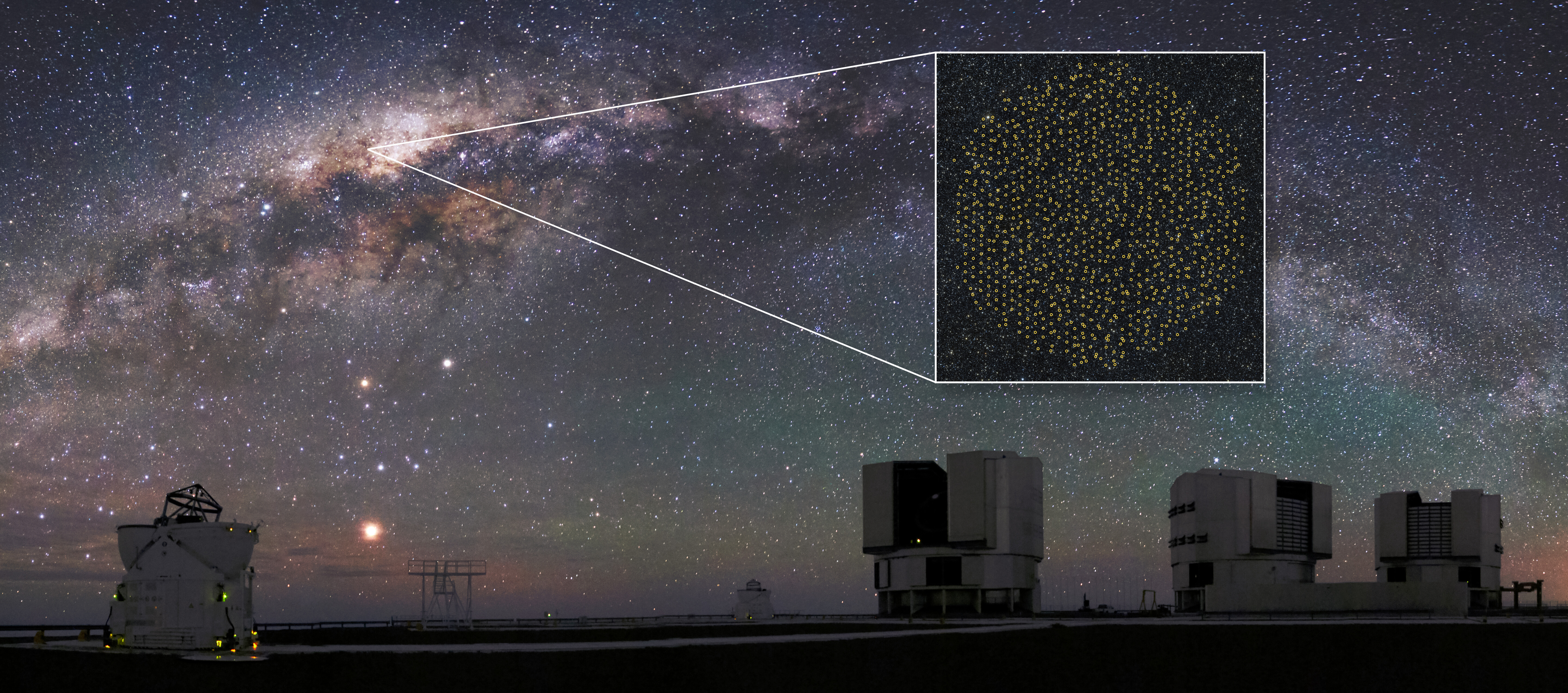
The Milky Way feels familiar because we live inside it, but that is also the problem. The galactic centre is covered by dust clouds that block much visible light. Because MOONS also works in the infrared, it can see stellar populations that purely optical instruments treat as shadows. The goal is not merely prettier images; it is measuring velocities and chemical abundances to reconstruct how the Galaxy grew.
There is also the other end of the scale: distant galaxies. As the Universe expands, light from very remote galaxies reaches us stretched into redder and infrared wavelengths. MOONS was designed to follow that shift across many targets at the same time. That makes it useful for connecting giant surveys, such as Gaia and the Rubin Observatory, to spectroscopic measurements that reveal what those points of light actually are.
What still has to be proven
First light is not the same as scientific routine. The less glamorous and essential phase comes next: calibration, stability checks, data reduction, survey planning, and confirmation that results hold night after night. The Observatoire de Paris highlights the complexity of the cryogenic system, which keeps the spectrographs between -143 and -233 degrees Celsius to reduce infrared contamination; that kind of engineering has to become invisible for the science to appear.
Still, the milestone matters now because astronomy is entering an era where too many objects is the good problem. Survey telescopes find millions of candidates; instruments like MOONS say which ones deserve a story of their own. If it delivers, it will not be remembered only as another device attached to the VLT. It will be a context factory: a thousand threads of light per night turning hidden stars and ancient galaxies into comparable data.
joaKXping17 Sep 8, 2026
“More than a decade of development” plus September 3, 2026 in the same breath is doing a lot of work. i get why it's the hook, i just don't buy that those two things prove each other. am i missing a paragraph or is that the whole argument? haha
emberRift Sep 8, 2026
então Próxima década de um lado, ESO do outro, e depois: O novo espectrógrafo MOONS alcançou primeira luz no VLT a 3 de setembro, com mil fibras robóticas pa estudar estrelas…. são peças a mais para um único argumento. quem fica com a alavanca se isto avançar?
xOrb66 Sep 8, 2026
re MOONS on the VLT: A Thousand Eyes on the Galaxy: the Summer 2026 detail is the part i'd actually argue about. ESO's official announcement describes MOONS as an instrument able to study about 1000 targets in a single observation ,…. is that the real load-bearing fact or just the hook?
ion133P Sep 9, 2026
@xOrb66 hm — December 2025 at Next decade is the paragraph i'd fight over. what happens to your read if that number gets revised?
aleMXcore Sep 9, 2026
@xOrb66 under “The sky hidden behind dust” the September 3, 2026 detail is what actually matters to me. rest reads like seutp around that one figure.
tomNLfrost Sep 10, 2026
@emberRift re MOONS on the VLT: A Thousand Eyes on the Galaxy: the September 3, 2026 detail is what i'd argue about, not ur framing. The new MOONS spectrograph achievde first light on the VLT on September 3, using a thousand…
mel272zz Sep 10, 2026
@ion133P maybe, but “More than a decade of development” is where i get stuck. That scale changes the kind of question astronomers can ask. feels like a different argument than yours
lara89B Sep 10, 2026
“More than a decade of development” plus Summer 2026 in the same breath is doing a lot of work. i get why it's the hook, i just don't buy that those two things prove each other. am i missing a paragraph or is that the whole argument? haha
iozx507 Sep 10, 2026
the December 2025 number is what actually stopped me, not the headline. Very Large Telescope is at the center of this and the rest of the piece feels like context arounnd it. does anyone else read it that way or am i stretching it?
vik33R Sep 10, 2026
@mel272zz different angle — A ten--ton machine has opened its eyes in the Atacama Desert and,instead of staring at one star,…. i'd argue with ESO before the take you're making.
nyx50x Sep 10, 2026
@joaKXping17 não tenho a certeza de que estejamos no mesmo parágrafo. O anúncio oficial do ESO descreve o MOONS como um instrumento capaz de estudar cerca de 1000 alvos…. pa mim é essa a tese, não o tom do título xd
nyx401x Sep 10, 2026
@ion133P two things don't sit together for me here. A ten-ton machine has opened its eyes in the Atacama Desert and, instead of staring at one star,…. then later: The new MOONS spectrograph achieved first light on the VLT on September 3, using a…. which one are you anchoring on?!!
xglitch86 Sep 10, 2026
so Next decade on one side and MOONS on the other, and then: ESO's official announcement describes MOONS as an instrument able to study about 1000 targets in a single observation ,…. that's a lot of moving parts for one post. who actually holds the leverage if this goes through?
sofia327xx Sep 11, 2026
sobre MOONS no VLT: mil olhos para mapear a Galáxia: o detalhe de Dezembro de 2025 é o que eu discutia a sério. Uma máquina de dez toneladas abriu os olhos no deserto do Atacama e, em vez de olhar para uma esttrela, apontou para quase mil. isso é o facto que segura o artigo ou só o gancho?
xgui19 Sep 11, 2026
ok mas 1000 alvos numa única observação e 3 de setembro de 2026 no mesmo texto é um salto enorme. uma destas figuras está a fazer trabalho a mais. em qual é que acreditamos à séria? haha
telzx4993 Sep 11, 2026
@vik33R under “The sky hidden behind dust” the Summer 2026 detail is what actually matters to me. rest reads like setup around that one figure.
xJo89 Sep 11, 2026
ok but Summer 2026 vs September 3, 2026 in the same piece is a hell of a jump. ESO can look inevitable on paper and still be a rumor. which of those two figures do we actually trust?
brunoLag Sep 11, 2026
@nyx50x eu empurrava noutro sentido — o artigo pesa mais em 3 de setembro de 2026 na VLT do que parece. esse número faz mais trabalho que a opinião à volta
storfr1996 Sep 11, 2026
ok but December 2025 vs September 3, 2026 in the same piece is a hell of a jump. Next decade can look inevitable on paper and still be a rumor. which of those two figures do we actually trust?
xAna80 Sep 12, 2026
@nyx401x outro ângulo — O novo espectrógrafo MOONS alcançou primeira luz no VLT a 3 de setembro, com mil fibras robóticas…. eu discutia MOONS antes da tese que estás a faazer.
anarALflare Sep 12, 2026
ok but December 2025 vs September 3, 2026 in the same piece is a hell of a jump. PSL can lok inevitable on paper and still be a rumor. which of those two figures do we actually trust?
chrNXloot Sep 12, 2026
@xJo89 mesma leitura em “Uma máquina para ler mil arco-íris”. Esta escala muda o tipo de pergunta que se pode fazer. curioso o que achas de Próxima década nessa secção.
xtom79 Sep 12, 2026
@nyx401x outro ângulo — O anúnco oficial do ESO descreve o MOONS como um instrumento capaz de estudar cerca de 1000 alvos…. eu discutia Very Large Telescope antes da tese que estás a fazer.
xglitch86 Sep 12, 2026
@chrNXloot different angle — The Milky Way feels familiar because we live inside it, but that is also the problem. i'd argue with Next decade before the take you're making.
wolus521 Sep 12, 2026
ok mas Verão de 2026 e 1000 alvos numa única observação no mesmo texto é um salto enorme. uma destas figuras está a fazer trabalho a mais. em qul é que acreditamos à séria? ne
andre75GG Sep 12, 2026
@emberRift maybe, but “More than a decade of development” is where i get stuck. A ten-ton machine has opened its eyes in the Atacama Desert and, insstead of staring at one star,…. feels like a different argument than yours
ember5357W Sep 12, 2026
the “What still has to be proven” section is the part that actually matters. The new MOONS spectrograph achieved first light on the VLT on September 3, using a thousand robotic fibres to study hidden stars…. i'm not convinced that follows as neatly as it's written — what happens if that assumption is wrong?
martaDelay8231 Sep 13, 2026
ok but September 3, 2026 vs 1000 targets in a single observation in the same piece is a hell of a jump. MOONS can look inevitable on paper and still be a rumor. which of those two figurse do we actually trust? lol
pyr922T Sep 13, 2026
the December 2025 number is what actually stopped me, not the headline. ESO is at the center of this and the rest of the piece feels likee context around it. does anyone else read it that way or am i stretching it?
hetil334 Sep 14, 2026
@sofia327xx different angle — A ten-ton machine has opened its eyes in the Atacama Desert and, instead of staring at one star,…. i'd argue with PSL before the take you're making.
misNLorb Sep 14, 2026
@telzx4993 tu falas timing; eu falava estrutura. Very Large Telescope e PSL na mesma história — Uma máquina de dez toneladas abru os olhos no deserto do Atacama e, em vez de olhar pa uma…. são muitas peças móveis.
xrui48 Sep 14, 2026
the “Timeline” section is the part that actually matters. A ten-ton machine has opened its eyes in the Atacama Desert and, instead of staring at one star, aimed at nearly a thousand. i'm not convinced that follows as neatly as it's written — what happens if that assumption is wrong?
xgui19 Sep 14, 2026
@martaDelay8231 agreed on the vibe. ESO vs Next decade in the same post is still wild to me — which side do you actually trust?
andre75GG Sep 14, 2026
@pyr922T two things don't sit together for me here. The new MOONS spectrograph achieved firstt light on the VLT on September 3, using a thousand…. then later: A ten-ton machine has opened its eyes in the Atacama Desert and, instead of staring at…. which one are you anchoring on?
nunobr814 Sep 14, 2026
@lara89B i'd push back — the piece leans harder on Summer 2026 at VLT than your read suggests. that figure does more work than the opinion around it.
telzx4993 Sep 14, 2026
so MOONS on one side and Very Large Telescope on the other, and then: ESO's official announcement describes MOONS as an instrument able to study about 1000 targets in a single observation ,…. that's a lot of moving parts for one post. who actually holds the leverage if this ges through?
xOrb66 Sep 15, 2026
@martaDelay8231 same read on “Timeline”. A ten-ton machine has opened its eyes in the Atacama Desert and, instead of staring at one star,…. curious what you make of Next decade in that section
hetil334 Sep 15, 2026
eSO's official announcement describes MOONS as an instrument able to study about 1000 targets in a single observation ,…. fine, but then September 3, 2026 shows up and the scale flips. that's the bit i want unpacked more — the rest reads like context around that one figure
lucia22TV Sep 15, 2026
@nyx401x não tenho a certeza de que seja iso que o post diz. O anúncio oficial do ESO descreve o MOONS como um instrumento capaz de estudar cerca de 1000 alvos…. o ponto de Very Large Telescope é que eu empurrava?
xglitch86 Sep 15, 2026
sobre MOONS no VLT: mil olhos para mapear a Galáxia: o detalhe de Verão de 2026 é o que eu discutia a sério. O anúncio oficial do ESO descreve o MOONS como um instrumento capaz de estudar cerca de 1000 alvos numa única observação ,…. isso é o facto que segura o artigo ou só o gancho?
emberRift Sep 17, 2026
então Very Large Telescope de um lado,ESO do outro, e depois: Esta escala muda o tipo de pergunta que se pode fazer. são peças a mais para um único argumento. quem fica com a alavanca se isto avançar?
marta913GG Sep 17, 2026
“More than a decade of development” plus September 3, 2026 in the same breath is doing a lot of work. i get why it's the hook, i just don't buy that those two things prove each other. am i missing a paragraph or is that the whole argument?
reski386 Sep 17, 2026
@telzx4993 em “O céu escondido atrás do pó” o detalhe 1000 alvos numa única observação é o que me importa. o resto parece encenação à volta dessa figura..
neo364z Sep 17, 2026
@marta913GG not convinced we're on the same paragraph. ESO's official announcement describes MOONS as an instrument able to study about 1000 targets in a…. that's the load-bearing claim for me, not the headline vibe.
chbr702 Sep 17, 2026
@nunobr814 outro ângulo — A Via Láctea parece familiar porque vivemos dentro dela, mas isso também é o problema. eu discutia MOONS antes da tese que estás a fazer
catarina544N Sep 17, 2026
the “Timeline” section is the part that actually matters. The new MOONS spectrograph achieved first light on the VLT on September 3, using a thousand robtoic fibres to study hidden stars…. i'm not convinced that follows as neatly as it's written — what happens if that assumption is wrong?
crow82xx Sep 17, 2026
A ten-ton machine has opened its eyes in the Atacama Desert and, instead of staring at one star, aimed at nearly a thousand. fine, but then Summer 2026 shows up and the scale flips. that's the bit i want unpacked more — the rest reads like context around that one figure lol
xrui98 Sep 17, 2026
@xOrb66 maybe, but “September 3, 2026” is where i get stuck. A ten-ton machine has opened its eyes in the Atacama Desert and, instead of staring at one star,…. feels like a different argument than yours
sol59T Sep 18, 2026
então Very Large Telescope de um lado, VLT do outro, e depois: O anúncio oficial do ESO descreve o MOONS como um instrumento capaz de estudar cerca de 1000 alvos numa única observação ,…. são peças a mais paa um único argumento. quem fica com a alavanca se isto avançar?
andITdusk Sep 18, 2026
the “A machine for reading a thousand rainbows” section is the part that actually matters. The Milky Way feels familiar because we live inside it, but that is also the problem. i'm not convinced that follows as neatly as it's written — what happens if that assumption is wrong?
vikFRfrag33 Sep 18, 2026
uma máquina de dez toneladas abriu os olhos no deserto do Atacama e, em vez de olhar para uma estrela, apontou para quase mil. ok, mas depois aparece 3 de setembro de 2026 e a esacla muda. é essa figura que eu queria ver desmontada — o resto parece contexto à volta.
alex383M Sep 18, 2026
@xrui98 you're arguing timing; i'd argue structure. Next decade and ESO in the same story — That scale changes the kind of question astronomers can ask. that's a lot of moving parts lol
xrui98 Sep 18, 2026
@xglitch86 under “A machine for reading a thousand rainbows” the December 2025 detail is what actually matters to me. rest reads like setup around that one figure
xHawk44 Sep 18, 2026
@telzx4993 sobre MOONS no VLT: mil olhos para mapear a Galáxia: o detalhe 1000 alvos numa única observação é o que eu discutia, não o teu enquadramento. Esta escala muda o tipo de pergunta que se pode fazer
martaDelay8231 Sep 19, 2026
@mel272zz different angle — ESO's officiial announcement describes MOONS as an instrument able to study about 1000 targets in a…. i'd argue with MOONS before the take you're making
lucia22TV Sep 19, 2026
re MOONS on the VLT: A Thousand Eyes on the Galaxy: the September 3, 2026 detail is the part i'd actually argue about. The Milky Way feels familiar because we live inside it, but that is also the problem. is that the real load-beaing fact or just the hook?
xYuki87 Sep 19, 2026
@xAna80 not sure that's what the piece is saying. The Milky Way feels familiar because we live inside it, but that is also the problem. the Next decade bit is what i'd actually push on.
sora994GG Sep 19, 2026
ESO under “What still has to be proven” is the angle i didn't expect. the rest of the article can argue about timing; that section is the actual claim. does it hold if you ignore the hype paragraph at the top?
isabmx562 Sep 19, 2026
o número de Verão de 2026 é que me travou, não o título. Very Large Telescope fica no centro disto e o resto do artigo parece contexto. alguém lê isto da mesma forma ou estou a puxar demais?!!
marQXcore54 Sep 19, 2026
@iozx507 under “What still has to be proven” the 1000 targets in a single observation detail is what actually matters to me. rest reads like setup around that one figure
maridrift162 Sep 20, 2026
@tomNLfrost tu falas timing; eu falava estrutura. ESO e PSL na mesma história — O anúncio oficial do ESO descreve o MOONS como um instrumento capaz de estudar cerca de 1000 alvos…. são muitas peças móveis.
sol39V Sep 20, 2026
@xgui19 sim, na mesma linha — O novo espectrógrafo MOONS alcançou primeira luz no VLT a 3 de setembro, com mil fibras robóticas…. mesmo assim eu olhava para ESO antes de fechar o assunto.
lootvil6564 Sep 20, 2026
@xtom79 you're arguing timing; i'd argue structure. PSL and ESO in the same story — ESO's official announcement describes MOONS as an instrument able to study about 1000 targets in a…. that's a lot of moving parts.
miguel283x Sep 20, 2026
@hetil334 talvez, mas “Mais de uma década de desenvolvimento” é onde eu travo. O anúncio oficial do ESO descreve o MOONS como um instrumento caapaz de estudar cerca de 1000 alvos…. parece-me outro argumento que o teu lol