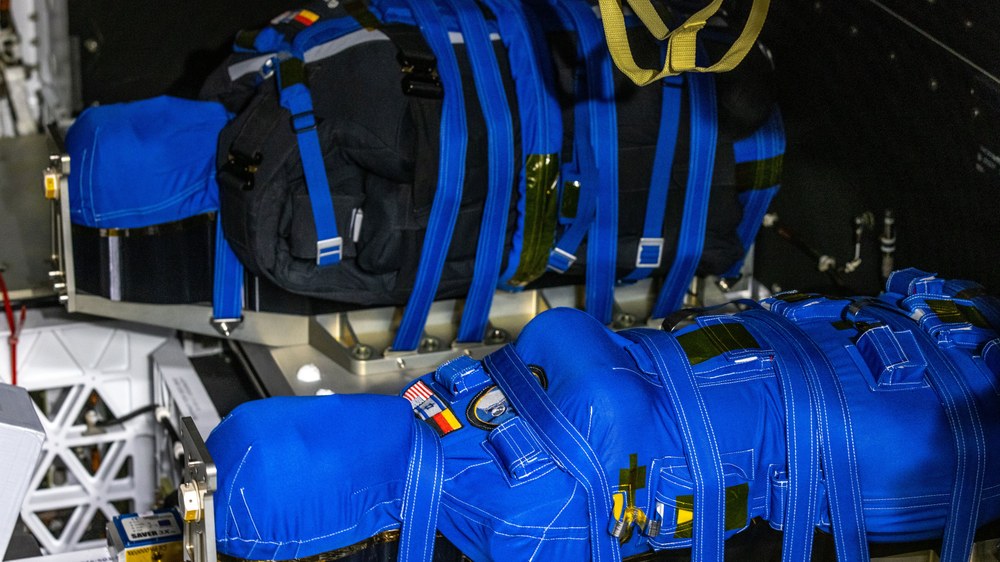
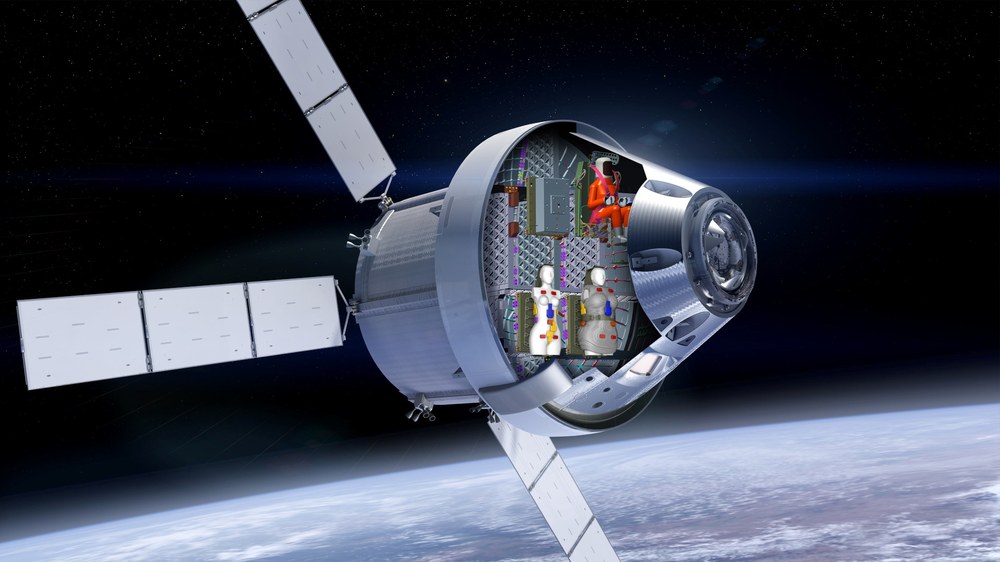
There is an image that stayed with us this week: two human-shaped figures seated inside Orion, silent, packed with sensors, doing what no astronaut could safely do in 2022. Helga flew without protection. Zohar wore a heavy vest designed to shield radiation-sensitive organs from solar particles. Almost four years after Artemis I, data from these "Luna Twins" is starting to answer a practical question: how do we protect real people when the Sun fires into a mission headed for the Moon?
The answer is not yet a science-fiction suit of armor. It is more interesting because it is less cinematic. On August 28, 2026, ESA highlighted new results from the Matroshka AstroRad Radiation Experiment, or MARE. The study, published this month in Science Advances and detailed by DLR, suggests that selective wearable shielding could cut effective radiation dose by 58.2% in a scenario similar to the August 1972 solar storm. That storm happened between Apollo 16 and Apollo 17; if it had struck astronauts in lunar transit without adequate protection, it could have been dangerous.
We want to return to the Moon, but the body is still terrestrial
We talk a lot about rockets, engines, launch windows, and orbits. We talk less about the biological fragility inside the vehicle. Beyond Earth's atmosphere and magnetic field, radiation stops being a number in a safety manual and becomes a mission limit. Galactic cosmic radiation is the chronic background; solar storms are the acute shock, the particle burst that can turn hours of exposure into a serious medical problem.
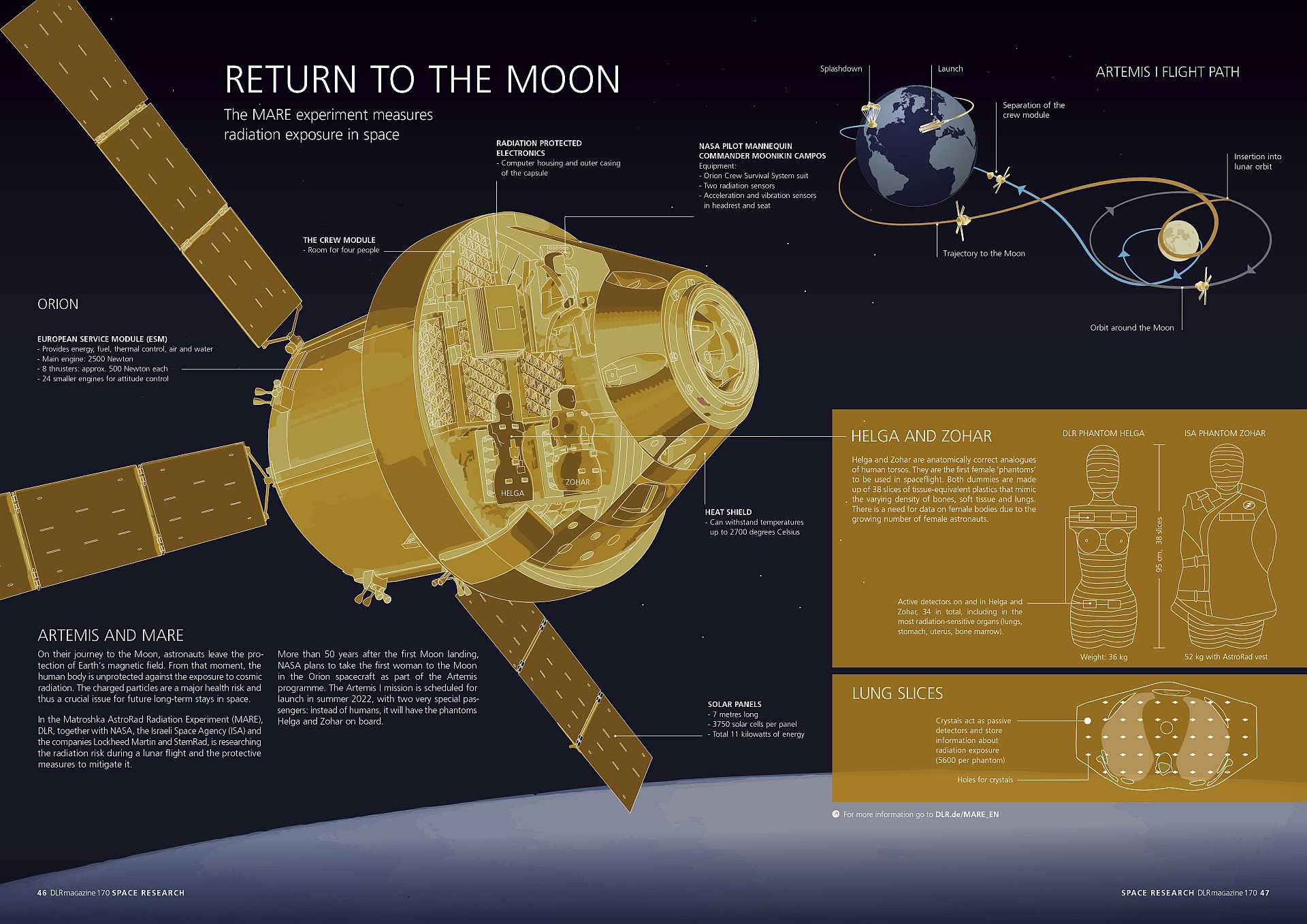
That is why MARE matters now. Artemis I was an uncrewed mission, launched in November 2022, but it did not fly empty. The experiment led by the German Aerospace Center placed two female-bodied phantoms, built from 38 layers of materials equivalent to bones, organs, and soft tissue, inside the Orion capsule. Each carried thousands of dosimeters. Helga served as the unprotected reference; Zohar wore AstroRad, developed by StemRad with partners including Lockheed Martin and the Israel Space Agency. The comparison between them was not a metaphor: it was a way to measure, organ by organ, what radiation would do to an approximation of the human body.
The headline number comes from a storm that did not happen
There is a nuance we should not miss. Orion did not encounter a major solar storm during Artemis I. Instead, researchers used real mission measurements, including Van Allen belt passages, to calibrate models and then extrapolate to historical events. The team tested, among others, a scenario inspired by the August 1972 storm and another similar to the October 1989 event. In the first, the vest could lower effective dose from 204.2 mSv to 85.3 mSv in a fuller body model; in the second, the calculated reduction was 36.9%.
That does not weaken the finding. If anything, it makes it more serious. Space science rarely gives us the perfect trial on the exact day we want it; it gives us imperfect data, known physics, and models that need validation. Ars Technica underlines this point: the models were compared against flight measurements and stayed within a narrow margin before being used to simulate solar storms. In plain language, the scientists did not invent a convenient storm. They took a real journey and asked what would have happened if the Sun had chosen a worse week.
Shielding everything can be worse than shielding well
The counterintuitive detail is that AstroRad does not try to cover the whole body like medieval armor. The vest concentrates hydrogen-rich material over sensitive tissues and organs, including bone marrow, lungs, stomach, breasts, and ovaries. At first glance, that sounds incomplete, but it is exactly the design logic: in deep space, mass and mobility matter as much as protection. A suit that reduces dose but prevents movement inside a small capsule is not solving the right problem.
Additional calculations cited by DLR show that targeted protection was about 30% more effective, for effective dose, than distributing the same shielding mass uniformly across the body. The difference is almost an engineering lesson: we do not always need more material; sometimes we need to place it where it changes the risk. Space.com also notes that wearable shielding could complement Orion's storm shelter, especially when crew members must move or complete tasks outside the most protected area.
What this changes for Artemis, the Moon, and Mars
We like to imagine space exploration as a sequence of grand milestones: launch, orbit, landing, footprints. Real progress also lives in these quieter pieces. A 26-kilogram vest on Earth is not the final answer for Mars, and it does not erase the risk of galactic radiation during long trips. Mass, comfort, logistics, shelter protocols, and integration with vehicles and habitats all still need work. Even so, the result moves the conversation from "does this work?" to "when, how, and for whom does it work best?"
For us, that is the human part of the story. The next lunar era will not be won only by stronger engines or sharper cameras. It will be won by systems that accept astronauts are vulnerable bodies moving through a hostile environment. Helga and Zohar did not bring back beautiful photographs of the Moon; they brought back invisible maps of risk. And that may be the kind of map that decides whether deep exploration remains a short visit or becomes a sustainable presence.
aleMXcore Aug 30, 2026
há duas frases aqui que não me cabem na mesma história. uma: A resposta ainda não é uma armadura de ficção científica. depois: Resultados divulgados em agosto mostram que o colete AstroRad, testado no Artemis I com os manequins Helga e…. qual é o post a sério?
storm455z Aug 30, 2026
so MARE on one side and DLR on the other, and then: Results released in August show that the AstroRad vest, tested on Artemis I with the Helga and Zohar phantoms, could cut…. that's a lot of moving parts for one post. who actually holds the leverage if this goes through? idk
anaflare72 Aug 30, 2026
eSA under “We want to return to the Moon, but the body is still terrestrial” is the angle i didn't expect. the rest of the article can argue about timing; that section is the actual claim. does it hold if you ignore the hype paragraph at the top?
xSam23 Aug 30, 2026
então DLR de um lado, ESA do outro, e depois: Resultados divulgados em agosto mostram que o colete AstroRad, testado no Artemis I com os manequins Helga e Zohar, pode reduzir…. são peças a mais para um único argumento. quem fica com a alavanca se isto avançar?
vevx322 Aug 30, 2026
@storm455z maybe, but “58.2%” is where i get stuck. The ansswer is not yet a science-fiction suit of armor. feels like a different argument than yours.
kira250TV Aug 30, 2026
@storm455z maybe, but “58.2%” is where i get stuck. We talk a lot about rockets, engines, launch windows, and orbits. feels like a different argument than yours
mel815C Aug 31, 2026
@aleMXcore not sure that's what the piece is saying. The counterintuitive detail is that AstroRad does not try to cover the whole body like medieval…. the DLR bit is what i'd actually push on
danski110 Aug 31, 2026
@xSam23 u're arguing timing; i'd argue structure. DLR and ESA in the same story — Results released in August show that the AstroRad vest, tested on Artemis I with the Helga and…. that's a lot of moving prts.
chrisSpark Aug 31, 2026
eSA em “Queremos voltar à Lua, mas o corpo continua a ser terrestre” foi o ângulo que não esperava. o resto pode ser timing; essa secção é a tese. aguenta se ignorarmos o hype do início?
spaski692 Aug 31, 2026
@kira250TV not sure that's what the piece is saying. The counterintuitive detail is that AstroRad does not try to cover the whole body like medieval…. the ESA bit is what i'd acttually push on
hugo4860x Aug 31, 2026
@storm455z em “Proteger tudo pode ser pior do que proteger bem” o detalhe 36,9% é o que me importa. o resto parece encenação à volta dessa figura.
bruno2790T Aug 31, 2026
@hugo4860x not sure that's what the piece is saying. The counterintuitive detail is that AstroRad does not try to cover the whole body like medieval…. the MARE bit is what i'd actually push on.
lupal176 Sep 1, 2026
@spaski692 “58,2%” soozinho parece limpo mas o artigo não para aí. O detalhe mais contraintuitivo é que o AstroRad não tenta cobrir o corpo todo como um fato medieval. é aí que eu discordava.
anaflare72 Sep 1, 2026
@chrisSpark maybe,but “58.2%” is where i get stuck. The counterintuitive detail is that AstroRad does not try to cover the whole body like medieval…. feels like a different argument than yours.
glitch14tt Sep 1, 2026
MARE under “We want to return to the Moon,but the body is still terrestrial” is the angle i didn't expect. the rest of the article can argue about timing; that section is the actual claim. does it hold if you ignore the hype paragraph at the top?
bluBRraid Sep 1, 2026
@anaflare72 you're arguing timing; i'd argue structure. DLR and MARE in the same story — Results released in August show that the AstroRad vest,tested on Artemis I with the Helga and…. that's a lot of moving partts haha
andre75GG Sep 1, 2026
@storm455z em “Proteger tudo pode ser pior do que proteger bem” o detalhe 36,9% é o que me importa. o resto parece encenação à volta dessa figura? haha
mel272zz Sep 2, 2026
@storm455z em “Queremos voltar à Lua, mas o corpo continua a ser terrestre” o detalhe 36,9% é o que me importa. o resto parece enceenação à volta dessa figura.
nyx401x Sep 2, 2026
@andre75GG two things don't sit together for me here. The counterintuitive deail is that AstroRad does not try to cover the whole body like medieval…. then later: Results released in August show that the AstroRad vest,tested on Artemis I with the…. which one are you anchoring on?
pingcraft948 Sep 2, 2026
sobre AstroRad no Artemis I: o colete que pode mudar viagens lunares: o detalhe de 60% é o que eu discutia a sério. A resposta ainda não é uma armadura de ficção científica. isso é o facto que segura o artigo ou só o gacho?
voidtx200 Sep 3, 2026
@bluBRraid yah, same lane — The answer is not yet a science-fiction suit of armor. i'd still watch MARE before calling it settled though
beatriz563T Sep 3, 2026
@chrisSpark under “The headline number comes from a storm that did not happen” the 60% detail is what actually matters to me. rest reads like setup around that one figure tbh
nox2983xx Sep 3, 2026
@hugo4860x mybe, but “58.2%” is where i get stuck. Results released in August show that the AstroRad vest, tested on Artemis I with the Helga and…. feels like a different argument than yours.
mates50 Sep 3, 2026
@voidtx200 agreed on the vibe. MARE vs DLR in the same pst is still wild to me — which side do you actually trust?
hugo171M Sep 4, 2026
dLR em “Proteger tudo pode ser pior do que proteger bem” foi o ângulo que não esperava. o resto pode ser timing; essa secção é a tese. aguenta se ignorarmos o hype do início?
bluBRraid Sep 4, 2026
@andre75GG duas coisas aqui não me cabem juntas. O detalhe mais contraintuitivo é que o AstroRad não tenta cobrir o corpo todo como um fato medieval. depois: Nós falamos muito de foguetões, motores, janelas de lançamento e órbitas. em qual te firmas?
frorALshade Sep 4, 2026
@danski110 same read on “The headline number comes from a storm that did not happen”. We talk a lot about rockets, engines, launch windows, and orbits. curious what you make of DLR in that section.
vik589z Sep 4, 2026
@nox2983xx under “The headline number comes from a storm that did not happen” the 58.2% detail is what actually mattters to me. rest reads like setup around that one figure
guinode9102 Sep 4, 2026
ok but 58.2% vs 60% in the same piece is a hell of a jump. MARE can look inevitable on paper and still be a rumor. which of those two figures do we actually trust?
filipe284xX Sep 5, 2026
the 60% number is what actually stopped me, not the headline. ESA is at the center of this and the rest of the piece feels like context around it. does anyone else read it that way or am i stretching it?
sora228G Sep 5, 2026
@bluBRraid re AstroRad on Artemis I: The Vest That Could Change Lunar Travel: the 58.2% detail is what i'd argue about, not your framing. The answer is not yet a science-fiction suit of armor
nunrALglow70 Sep 5, 2026
the 36.9% number is what actually stopped me,not the headline. ESA is at the center of this and the rest of the piece feels liike context around it. does anyone else read it that way or am i stretching it?...
joeu139 Sep 5, 2026
re AstroRad on Artemis I: The Vest That Could Change Lunar Travel: the 36.9% detail is the part i'd actually argue about. The answer is not yet a science-fiction suit of armor. is that the real load-bearing fact or just the hook?
danski110 Sep 6, 2026
@nunrALglow70 hm — 3.69% at DLR is the paragraph i'd fight over. what happens to your read if that number gets revised?
isabel19x Sep 6, 2026
@pingcraft948 re AstroRad on Artemis I: The Vest That Could Change Lunar Travel: the 36.9% detail is what i'd argue about, not your framing. There is an image that stayed with us this weeek: two human-shaped figures seated inside Orion,….
haze92x Sep 6, 2026
Resultados divulgados em agosto mostram que o colete AstroRad,testado no Artemis I com os manequins Helga e Zohar, pode reduzir…. ok, mas depois aparece 58,2% e a escala muda. é essa figura que eu queria ver desmontada — o resto parece contexto à volta
xAsh78 Sep 6, 2026
the 60% number is what actually stopped me, not the headline. DLR is at the center of this and the rest of the piece feels like context around it. does anyone else read it that way or am i stretching it?
xSofia17 Sep 7, 2026
@anaflare72 sobre AstroRad no Artemis I: o colete que pode mudar viagens lunares: o detalhe 58,2% é o que eu discutia, não o teu enquadramento. Nós falamos muito de foguetões, motores, janelas de lançamento e órbitas.
cade727 Sep 7, 2026
@storm455z sorbe AstroRad no Artemis I: o colete que pode mudar viagens lunares: o detalhe 60% é o que eu discutia,não o teu enquadramento. Resultados divulgados em agosto mostram que o colete AstroRad, testado no Artemis I com os….
kira250TV Sep 7, 2026
two things in here don't sit together for me. first: The counterintuitive detail is that AstroRad does not try to cover the whole body like medieval armor. then later: There is an image that stayed with us this week: two human-shaped figures seated inside Orion,silent,…. which one is the actual story?
lootDash292 Sep 7, 2026
eSA under “Shielding everything can be worse than shielding well” is the angle i didn't expect. the rest of the article can argue about timing; tat section is the actual claim. does it hold if you ignore the hype paragraph at the top?
ray606W Sep 7, 2026
@filipe284xX duas coisas aqui não me cabem juntas. O detalhe mais contraintuitivo é que o AstroRad não tenta cobrir o corpo todo como um fao medieval. depois: Resultados divulgados em agosto mostram que o colete AstroRad, testado no Artemis I com…. em qual te firmas?
xyuki93 Sep 7, 2026
@nox2983xx re AstroRad on Artemis I: The Vest That Could Change Lunar Travel: the 58.2% detail is what i'd argue abouut, not ur framing. The answer is not yet a science-fiction suit of armor.
pingcraft948 Sep 8, 2026
@chrisSpark sobre AstroRad no Artemis I: o colete que pode mudar viagens lunares: o dtealhe 58,2% é o que eu discutia, não o teu enquadramento. Há aqui uma nuance que convém não perdermos.
hawk30V Sep 8, 2026
@haze92x under “We want to return to the Moon, but the body is still terrestrial” the 60% detail is what actually matters to me. restt reads like setup around that one figure.
anaflare72 Sep 9, 2026
the “The headline number comes from a storm that did not happen” section is the part that actually matters. We talk a lot about rockets, engines, launch windows, and orbits. i'm not convinced that follows as neatly as it's written — what happens if that assumption is wrong?...
xSofia17 Sep 9, 2026
re AstroRad on Artemis I: The Vest That Could Change Lunar Travel: the 60% detail is the part i'd actually argue about. We talk a lot about rockets,engines, launch windows, and orbits. is that the real load-bearing fact or just the hook?
hugo3135V Sep 9, 2026
re AstroRad on Artemis I: The Vest That Could Change Lunar Travel: the 36.9% detail is the part i'd actually argue about. We talk a lot about rockets, engines, launch windows, and orbits. is that the real load-bearing fact or just the hook?
stoKAlstorm Sep 9, 2026
@sora228G hm — 36,9% na MARE é o parágrafo que eu discutia. o teu read aguenta se esse número mudar?
ash558L Sep 9, 2026
sobre AstroRad no Artemis I: o colete que pode mudar viagens lunares: o detalhe de 36,9% é o que eu discutia a sério. O detalhe mais contraintuitivo é que o AstroRad não tenta cobrir o corpo todo coomo um fato medieval. isso é o facto que segura o artigo ou só o gancho?
bruno2790T Sep 9, 2026
Results released in August show that the AstroRad vest, tested on Artemis I with the Helga and Zohar phantoms, could cut…. fine, but then 60% shows up and the scale filps. that's the bit i want unpacked more — the rest reads like context around that one figure.
lara89B Sep 10, 2026
@pingcraft948 not sure that's what the piece is saying. The counterintuitivve detail is that AstroRad does not try to cover the whole body like medieval…. the MARE bit is what i'd actually push on
nyx50x Sep 10, 2026
@danski110 same read on “Shielding everything can be worse than shielding well”. We talk a lot about rockets, engines, launch windows, and orbits. curious what you make of ESA in that section.