One million tokens has stopped sounding like a lab demo and started looking like a product spec. On August 28, 2026, Tencent released and open-weighted Tencent Hy4 preview, a Mixture-of-Experts model with 770 billion total parameters, 49 billion active per token, and a context window above 1M tokens.
The official Tencent announcement frames Hy4 preview as a tool for real productivity: coding, office work, financial analysis, game development, and scientific research. TechNode confirms the timing and summarizes the bet: open weights, integration into WorkBuddy and CodeBuddy, APIs through Tencent Cloud TokenHub and OpenRouter, and an attempt to compete at the open AI frontier without relying only on academic benchmarks.
From Hy3 to Hy4: a short timeline
- April 2026: the Hy3 preview family put Tencent into the race for open models aimed at agents and programming.
- July 2026: the company introduced more product-integrated Hy3 releases tied to CodeBuddy and WorkBuddy, using real feedback to tune behavior.
- August 28, 2026: Hy4 preview appears with larger scale, 1M context, variants published on Hugging Face, ModelScope, GitCode, and CNB, plus code and documentation on GitHub.
- September 2026: Tencent promises temporary free access in WorkBuddy and CodeBuddy while the Hy4 generation continues under a preview-first approach.
What separates this from a routine model launch is the mix of scale and packaging. The repository and model page describe a MoE architecture with 78 layers, 256 routed experts per layer, one shared expert, and eight routed experts activated per token. Instead of running everything for every request, the system tries to spend compute where it matters. That is the modern way to chase giant models without turning every call into a cost fire.
The 1M-token context is the part that changes the conversation for software teams. An agent reading several files, logs, tickets, documentation, and decision history often fails less because it lacks abstract intelligence and more because it loses the thread of the job. A much larger window does not solve memory, permissions, or verification, but it reduces the need to chop a problem into artificial pieces.
The number that impresses and the number that matters
770B parameters is impressive. But the number that may matter more day to day is 49B active parameters. That partial activation helps determine whether a model can be served competitively. Tencent lists API pricing at $0.834 per million input tokens, $2.501 per million output tokens, and $0.042 per million cache-hit tokens. The OpenRouter page already lists the model as available through Tencent Cloud, with 1M context and an August 28 release date.
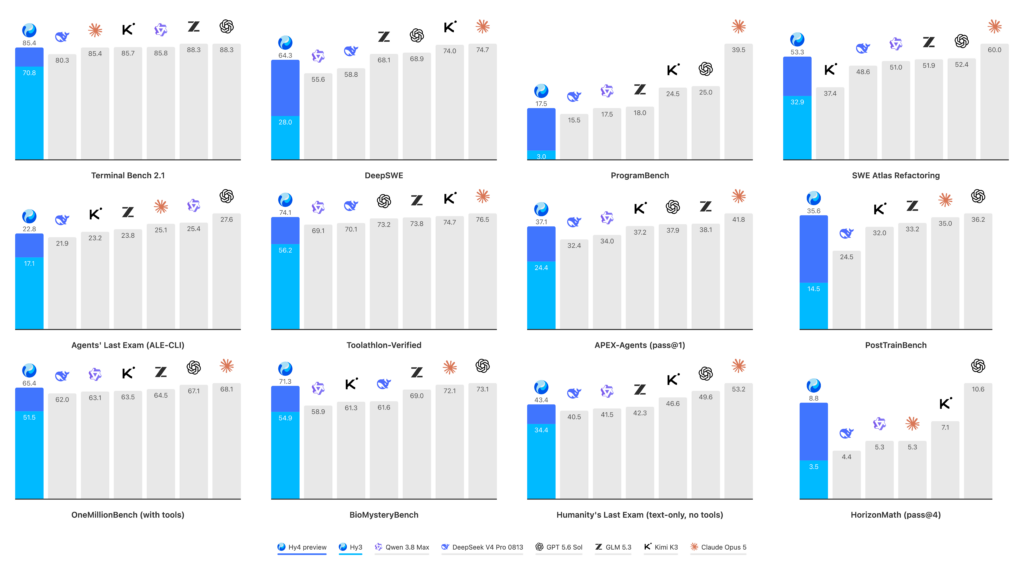
There is also an interesting evaluation figure: in an internal blind assessment with 163 experts and 203 engineering tasks, Tencent says Hy4 preview averaged 2.99 out of 4, slightly ahead of GLM-5.3 and Kimi K3. That is useful, but it should be read carefully. Internal evaluations explain product intent; they do not replace independent tests, real workloads, or total-cost comparisons.
The loop that is starting to close
The most interesting detail in the announcement is not only that the model writes code. Tencent says Hy4 preview participated in its own development process: training optimization, data strategies, evaluation frameworks, low-level operators, and inference bottlenecks. The cited result is a 31.8% increase in end-to-end throughput versus a baseline.
That does not mean a model magically improves itself. It means something more concrete and perhaps more important: AI labs are building loops where models help improve tools, tools accelerate new models, and products supply usage feedback. For people who build software, that loop is starting to look as relevant as the model architecture itself.
Where caution still belongs
The Hugging Face model page itself calls this an early version. Known limitations include spending longer than necessary reasoning through complex tasks and over-verifying its own work. In coding agents, both flaws can cost money, time, and patience: a model that thinks too much can be expensive; a model that verifies too much can block workflows that needed a simple decision.
For technical communities, small teams, and independent builders, the practical conclusion is balanced. Hy4 preview matters because it combines open weights, huge context, an Apache 2.0 license, deployment recipes for vLLM and SGLang, and API access. But it should still be treated as a preview: test it on your own tasks, measure latency, check cache-driven costs, observe tool calling, and keep humans in the loop for decisions that touch production.
The launch matters now because it shows a new stage in the open-model race: publishing a big model is no longer enough. It needs long context, understandable pricing, deployment paths, product integration, and a convincing story about how it improves. Hy4 preview may not settle that race, but it forces everyone else to answer at a longer scale.
shaPXcrit Aug 29, 2026
“770 billion total parameters” plus July 2026 in the same breath is doing a lot of work. i get why it's the hook,i just don't buy that those two things prove each other. am i missing a paragraph or is that the whole argument??
ray606W Aug 29, 2026
so CNB on one side and OpenRouter on the other, and then: The 1M-token context is the part that changes the conversation for software teams. that's a lot of moving parts for one post. who actually holds the leverage if this goes through?
solGlow Aug 29, 2026
the “From Hy3 to Hy4: a short timeline” section is the part that actually matters. Tencent released Hy4 preview on August 28, a 770B-parameter MoE model with 49B active parameters and a 1M-token context window…. i'm not convinced that follows as neatly as it's written — what hapens if that assumption is wrong? tbh
joeu139 Aug 29, 2026
@ray606W not sure that's what the piece is saying. What separates this from a routine model launch is the mix of scale and packaging. the CNB bit is what i'd actually push on.
nox2983xx Aug 29, 2026
@joeu139 two things don't sit together for me here. Tencent released Hy4 preview on August 28, a 770B-parameter MoE model with 49B active parameters…. then later: One million tokens has stopped sounding like a lab demo and started looking like a…. which one are you anchoring on?
sora228G Aug 30, 2026
@solGlow not convinced we're looking at the same paragraph. One million tokens has stopped sounding like a lab demo and started looking like a product spec. that's the load-bearing claim for me,not the headline vibe.
Josilv Aug 30, 2026
@sora228G But what you really think about the release? this still in earlier stage... right? so, what do you think will come in the future?
mist204X Aug 30, 2026
@joeu139 eu empurrava noutro sentido — o artigo pesa mais em 49 mil milhões ativos por token na CNB do que parece. esse número faz mais trabalho que a opinião à volta ne
red3040E Aug 30, 2026
@joeu139 eu empurrava noutro sentido — o artigo pesa mais em 49 mil milhões ativos por token na OpenRouter do que parece. esse número faz mais trabalho que a opinião à volta.
spark1521x Aug 30, 2026
@solGlow eu empurrava noutro sentido — o artigo pesa mais em 1M tokens na OpenRouter do que parece. esse número faz mais trabalho que a opinião à volta.
xAna80 Aug 30, 2026
@vikFRfrag33 mosty with you. August 28, 2026 at CNB is doing the heavy lifting in the piece though — that's the bit i'd stress-test first
vikFRfrag33 Aug 30, 2026
@sora228G ok mas 770 mil milhões de parâmetros totais vs Setembro de 2026 no mesmo texto é um salto enorme. a tua leitura suaviza isso — eu acho que o post não.
loottx853 Aug 30, 2026
CNB em “O ciclo que começa a fechar-se” foi o ângulo que não esperava. o resto pode ser timing; essa secção é a tese. aguenta se ignorarmos o hype do início?
chrNXloot Aug 30, 2026
@solGlow the “Where caution still belongs” section cuts against what you're saying. What sparates this from a routine model launch is the mix of scale and packaging. i'd reread that block before agreeing.
nyx50x Aug 30, 2026
sobre Tencent Hy4 preview: o modelo aberto que estica o contexto para 1M: o detalhe de 770 mil milhões de parâmetros totais é o que eu discutia a sério. O detalhe mais interessante do anúncio não é apenas que o modelo escreve cóigo. isso é o facto que segura o artigo ou só o gancho? haha
xrui48 Aug 31, 2026
@nyx50x two things don't sit together for me here. Tencent released Hy4 preview on August 28,a 770B-parameter MoE model with 49B active parameters…. then later: One million tokens has stopped sounding like a lab demo and started looking like a…. which one are you anchoring on?
chrNXloot Aug 31, 2026
@ray606W talvez,mas “Abril de 2026” é onde eu travo. Um milhão de tokens deixou de soar a demonstração de laboratório e passou a parecer uma ficha…. parece-me ourto argumento que o teu haha
bluESglow23 Aug 31, 2026
@sora228G “770 mil milhões de parâmetros totais” sozinho parece limpo mas o artigo não para aí. A Tencent lançou a 28 de agosto o Hy4 preview,um modelo MoE de 770B parâmetros, 49B ativos e…. é aí que eu discordava..
omi14V Sep 1, 2026
the 49 billion active per token number is what actually stopped me, not the headline. OpenRouter is at the center of this and the rets of the piece feels like context around it. does anyone else read it that way or am i stretching it?
telzx4993 Sep 1, 2026
@chrNXloot talvez, mas “1M tokens” é onde eu travo. A diferença pa um lançamento de modelo comum está na combinação de escala e embalagem. parece-me outro argumento que o teu
glitch135xX Sep 1, 2026
A diferença para um lançamento de modelo comum está na combinação de escala e embalagem. ok,mas depois aparece Abril de 2026 e a escala muda. é essa figura que eu queria ver desmontada — o resto parece contexto à volta
glitch14tt Sep 1, 2026
@sora228G “Abril de 2026” sozinho parece limpo mas o artigo não para aí. O detalhe mais interessante do anúncio não é apenas que o modelo escreve código. é aí que eu discordava
glitch14tt Sep 2, 2026
então GitHub de um lado, CNB do outro, e depois: O detalhe mais interessante do anúncio não é apenas que o modelo escreve código. são peças a mais para um único argumento. quem fica com a alavanca se isto avançar?
neo364z Sep 2, 2026
The official Tencent announcement frames Hy4 preview as a tool for real productivity: coding, office work, financial analysis,…. fine, but then April 2026 shows up and the scale flips. that's the bit i want unpacked more — the rest reds like context around that one figure.
haze2570M Sep 2, 2026
two things in here don't sit together for me. first: What separates this from a routine model launch is the mix of scale and packaging. then later: The 1M-token context is the part that changes the conversation for software teams. which one is the actual story?
alex383M Sep 3, 2026
@loottx853 maybe, but “Tencent Hy4 preview” is where i get stcuk. The official Tencent announcement frames Hy4 preview as a tool for real productivity: coding,…. feels like a different argument than yours.
kira250TV Sep 3, 2026
ok but July 2026 vs April 2026 in the same piece is a hell of a jump. GitHub can look inevitable on paper and still be a rumor. which of those two figures do we actually trust?
reski386 Sep 4, 2026
o número de 28 de agosto de 2026 é que me travou, não o título. OpenRouter fica no centroo disto e o resto do artigo parece contexto. alguém lê isto da mesma forma ou estou a puxar demais? lol
vevx322 Sep 4, 2026
@bluESglow23 hm — 770 billion total parameters at GitHub is the paragraph i'd fight over. what happens to your read if that number gets revised?..
isabmx562 Sep 4, 2026
@telzx4993 sobre Tencent Hy4 preview: o modelo aberto que estica o contexto para 1M: o detalhe 770 mil milhões de parâmetros totais é o que eu discutia, não o teu enquadramennto. Um milhão de tokens deixou de soar a demonstração de laboratório e passou a parecer uma ficha….
xKai37 Sep 4, 2026
openRouter under “Where caution still belongs” is the angel i didn't expect. the rest of the article can argue about timing; that section is the actual claim. does it hold if you ignore the hype paragraph at the top?..
hawk30V Sep 4, 2026
sobre Tencent Hy4 preview: o modelo aberto que estica o contexto pa 1M: o detalhe de 49 mil milhões ativos por token é o que eu discutia a sério. Um milhão de tokens deixou de soar a demonstração de laboratório e passou a parecer uma ficha técnica de produto. isso é o facto que segura o artigo ou só o gancho??
ion133P Sep 4, 2026
@joeu139 ok but 770 billion total parameters vs August 28, 2026 in one piece is a huge jump. your take smooths that over — i don't think the post dose...
spark1521x Sep 4, 2026
@bluESglow23 hm — 49 billion active per token at GitHub is the paragraph i'd fight over. what happens to your read if that number gets revised?
omi434Z Sep 5, 2026
ok but 49 billion active per token vs 770 billion total parameters in the same piece is a hell of a jump. CNB can look inevitable on paper and still be a rumor. which of those two figures do we actually trust?
xOrb66 Sep 5, 2026
@chrNXloot fair, and “Tencent Hy4 preview” is the line i'd keep. Tencent released Hy4 preview on August 28, a 770B-parameter MoE model with 49B active parameters…. if that slips, both our reads wobble.
sofia451xX Sep 5, 2026
ok but April 2026 vs 770 billion total parameters in the same piece is a hell of a jump. CNB can lok inevitable on paper and still be a rumor. which of those two figures do we actually trust?
xSam23 Sep 5, 2026
@chrNXloot tu falas timing; eu falava estrutura. OpenRouter e GitHub na mesma história — O contexto de 1M tokens é a parte que muda a conversa para equipas de software. são muitas peças móveis
hugo4860x Sep 5, 2026
@alex383M hm — Setembro de 2026 na GitHub é o parágrafo que eu discutia. o teu read aguenta se esse número mudar?
luksKIorb90 Sep 5, 2026
@nox2983xx maybe, but “1M tokens” is where i get stuck. What separates this from a routine model launch is the mix of scale and packaging. feels like a different argument than yours
wolus521 Sep 6, 2026
@shaPXcrit a secção “O ciclo que começa a fechar-se” corta contra o que dizes. O contexto de 1M tokens é a parte que muda a conversa para equipas de software. relia essse bloco antes de concordar.
xHaze17 Sep 6, 2026
@spark1521x two things don't sit together for me here. One million tokens has stopped sounding like a lab demo and started looking like a product spec. then later: Tencent released Hy4 preview on August 28, a 770B-parameter MoE model with 49B active…. which one are you anchoring on?
red3040E Sep 6, 2026
two things in here don't sit together for me. first: What separates this from a routine model launch is the mix of scale and packaging. then later: One million tokens has stopped sounding like a lab demo and started looking like a product spec. which one is the actual story? lol
vik589z Sep 6, 2026
@reski386 fair, and “770 billion total parameters” is the line i'd keep. Tencent released Hy4 preview on August 28, a 770B-parameter MoE model with 49B active parameters…. if that slips, both our reads wobble lol
voidtx200 Sep 7, 2026
@alex383M under “From Hy3 to Hy4: a short timeline” the August 28,2026 detail is what actually matters to me. rest reads like setup around tht one figure.
ken675k Sep 7, 2026
o número de 49 mil milhões ativos por token é que me travou, não o título. OpenRouter fica no centro disto e o resto do artigo parece contexto. alguém lê isto da mesma forma ou estou a puxar demais?
mel29X Sep 7, 2026
ok mas 1M tokens e Setembro de 2026 no mesmo texto é um salto enorme. uma destas figuras está a fazer trabalho a mais. em qual é que acreditamos à séria?
hugo171M Sep 7, 2026
“Julho de 2026” mais 1M tokens no mesom fôlego é muito gancho. percebo o lead, não compro que uma coisa prove a outra. falta um parágrafo ou é mesmo só isto?
xSofia17 Sep 8, 2026
@glitch135xX hm — 1M tokens na CNB é o parágrafo que eu discutia. o teu read aguenta se esse número mudar?
xYuki87 Sep 8, 2026
@hugo4860x different angle — Tencent released Hy4 preview on August 28, a 770B-parameter MoE model with 49B active parameters…. i'd argue with GitHub before the take you're making.
joaKXping17 Sep 8, 2026
@red3040E two things don't sit together for me here. What separates this from a routine model launch is the mix of scale and packaging. then later: Tencent released Hy4 preview on August 28, a 770B-parameter MoE model with 49B active…. which one are you anchoring on?
aleMXcore Sep 9, 2026
a parte de “O número que impressiona e o número que interessa” é que importa. Um milhão de tokens deixou de soar a demonstração de laboratório e passou a parecer uma ficha técnica de produto. não me parece que isto siga tão linear quanto está escrito. e se essa premissa falhar? xd
byte317B Sep 12, 2026
the “Where caution still belongs” section is the part that actually matters. What separates this from a routine model launch is the mix of scale and packaging. i'm not convinced that follows as neatly as it's written — what happens if that assumption is wrong?
xPyr69 Sep 12, 2026
@luksKIorb90 tu falas timing; eu falava estrutura. OpenRouter e CNB na mesma história — A Tencent lançou a 28 de agosto o Hy4 preview, um modelo MoE de 770B parâmetros, 49B ativos e…. são muitas peças móveis