The surprise came from a place where scientists expected a cleaner story. On September 21, 2026, NASA and JPL released new results from the Perseverance rover in the Margin Unit, a band along the inner rim of Mars’ Jezero Crater. The initial hypothesis was almost intuitive: if the area followed the edge of an ancient lake and showed carbonates from orbit, perhaps it preserved sedimentary rocks formed in calm water.
What the rover found was messier and more interesting. According to JPL’s official report, the rocks analyzed there were mostly igneous, rich in olivine, and recorded at least three different episodes of interaction with water: carbon-dioxide-rich groundwater, contact with Jezero’s ancient lake, and later hot fluids circulating through volcanic rocks. For the search for ancient habitability, that shifts the question from “was there water?” to “how many different waters passed through here?”.
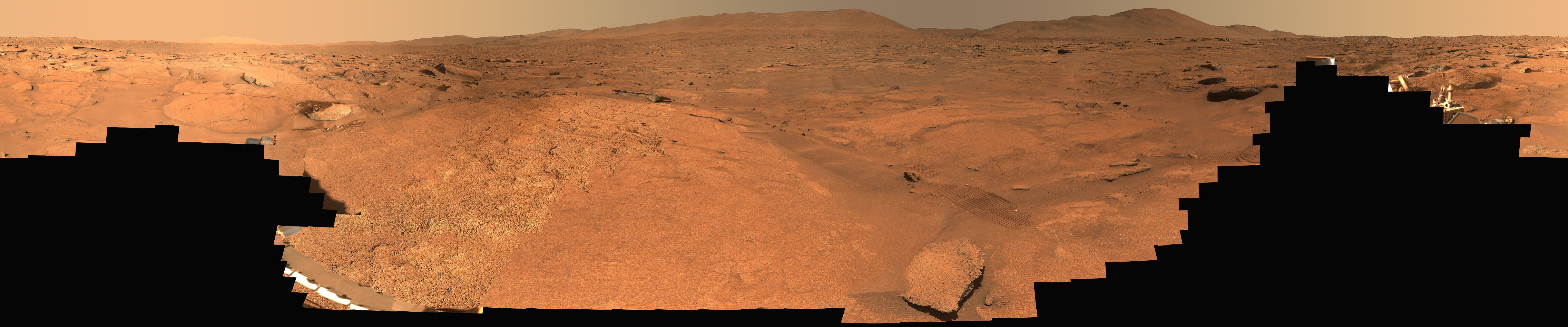
What is the Margin Unit?
It is a geological zone along the inner edge of Jezero Crater, where Perseverance explored roughly 265 meters of elevation change. The area matters because it sits within one of the largest known exposures of carbonates on Mars. On Earth, carbonates can form in watery environments capable of preserving chemical traces of past life, which made this target especially attractive for the mission.
Why did the discovery surprise the team?
Orbital data suggested a setting dominated by lake sediments. On the ground, however, the rover found coarse, crystalline rocks typical of igneous material that cooled slowly underground before later being exposed at the surface. That does not make the site less interesting. If anything, igneous rocks can preserve a precise chemical chronology, like mineral archives of the moment they formed and the changes they experienced afterward.
How many times does water appear in this story?
The sequence described in the study published in Communications Earth & Environment points to three phases. First, CO2-rich groundwater reacted with olivine and left carbonate-filled fractures. Then, some rocks below the old water line showed more silica, consistent with interaction with the lake. Finally, veins of calcium sulfate and fluorite suggest a later hydrothermal event, with hot water moving through the subsurface.

Does this prove there was life on Mars?
No. The discovery is not a biological signature. What it does is make Jezero richer from an astrobiology perspective. Carbonate and silica matter because, on Earth, they can trap chemical and textural traces of ancient environments. In addition, the reaction between water and olivine can release hydrogen, an energy source for some terrestrial microbes. The right word here is not proof; it is preservation potential.
Why does this matter now?
Perseverance is not merely taking pictures of Mars. It is building a list of samples and contexts that may define what we look for when we talk about ancient Mars. The Margin Unit shows that an orbital reading can catch the broad signal, the carbonates, while missing the full story. Instead of a simple lake, Jezero appears to have been a crossroads of lake water, groundwater, and hydrothermal circulation.
What is the next scientific step?
The rover can order the events, but it cannot yet date them with absolute precision. That is why the sample story remains crucial. If materials like those from the Margin Unit reach Earth laboratories, scientists will be able to measure ages, microscopic textures, and chemical signatures with far more sensitive instruments. Until then, the conclusion is already strong: Mars did not just have water; it had different water systems, at different moments, rewriting the same rock.
voidtx200 Sep 22, 2026 11:11 PM
o número de 21 de setembro de 2026 é que me travou, não o título. CO2 fica no centro disto e o resto do artigo parece contexto. alguuém lê isto da mesma forma ou estou a puxar demais?
filipe284xX Sep 22, 2026 6:51 PM
“three different episodes of interaction with water” plus 265 meters of elevation change in the same breath is doing a lot of work. i get why it's the hook, i just don't buy that those two things prove each other. am i missing a paagraph or is that the whole argument?...
storm455z Sep 22, 2026 5:20 PM
@vikFRfrag33 duas coisas aqui não me cabem juntas. Os dados orbitais sugeriam um ceánrio dominado por sedimentos lacustres. depois: É uma zona geológica que acompanha a margem interior da cratera Jezero, onde…. em qual te firmas?
vikFRfrag33 Sep 22, 2026 5:10 PM
@xgui19 sobre Perseverance encontrou três histórias de água em Jezero: o detalhe 265 metros de diferença de elevação é o que eu discutia, não o teu enquadramento. A surpresa veio de uma zona onde os cientistas esperavam uma história simples
xgui19 Sep 22, 2026 11:07 AM
so Margin Unit on one side and NASA on the other, and then: New NASA/JPL results show that Jezero Crater’s Margin Unit preserved groundwater, an ancient lake, and hydrothermal fluids in…. that's a lot of moving parts for one post. who actually holds the leverage if this goes through?