The surprise came from a place where scientists expected a cleaner story. On September 21, 2026, NASA and JPL released new results from the Perseverance rover in the Margin Unit, a band along the inner rim of Mars’ Jezero Crater. The initial hypothesis was almost intuitive: if the area followed the edge of an ancient lake and showed carbonates from orbit, perhaps it preserved sedimentary rocks formed in calm water.
What the rover found was messier and more interesting. According to JPL’s official report, the rocks analyzed there were mostly igneous, rich in olivine, and recorded at least three different episodes of interaction with water: carbon-dioxide-rich groundwater, contact with Jezero’s ancient lake, and later hot fluids circulating through volcanic rocks. For the search for ancient habitability, that shifts the question from “was there water?” to “how many different waters passed through here?”.
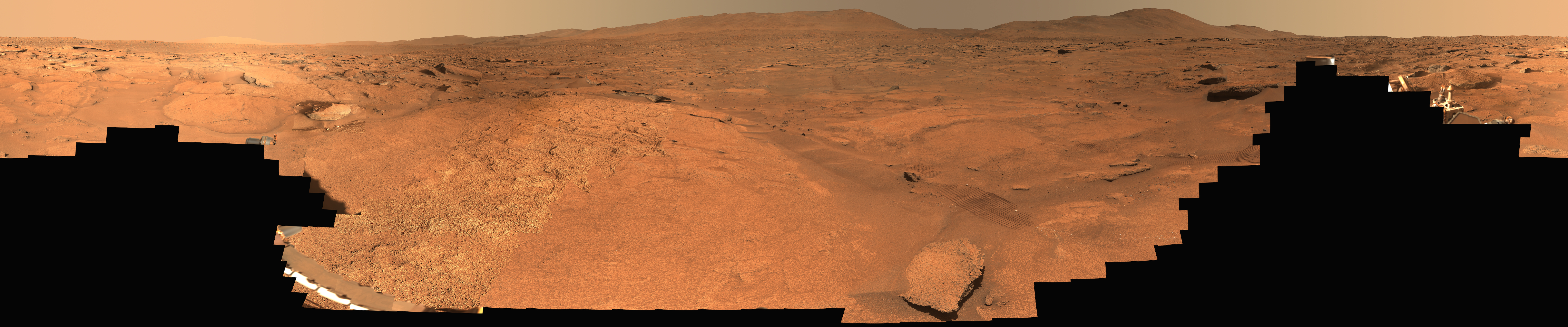
What is the Margin Unit?
It is a geological zone along the inner edge of Jezero Crater, where Perseverance explored roughly 265 meters of elevation change. The area matters because it sits within one of the largest known exposures of carbonates on Mars. On Earth, carbonates can form in watery environments capable of preserving chemical traces of past life, which made this target especially attractive for the mission.
Why did the discovery surprise the team?
Orbital data suggested a setting dominated by lake sediments. On the ground, however, the rover found coarse, crystalline rocks typical of igneous material that cooled slowly underground before later being exposed at the surface. That does not make the site less interesting. If anything, igneous rocks can preserve a precise chemical chronology, like mineral archives of the moment they formed and the changes they experienced afterward.
How many times does water appear in this story?
The sequence described in the study published in Communications Earth & Environment points to three phases. First, CO2-rich groundwater reacted with olivine and left carbonate-filled fractures. Then, some rocks below the old water line showed more silica, consistent with interaction with the lake. Finally, veins of calcium sulfate and fluorite suggest a later hydrothermal event, with hot water moving through the subsurface.

Does this prove there was life on Mars?
No. The discovery is not a biological signature. What it does is make Jezero richer from an astrobiology perspective. Carbonate and silica matter because, on Earth, they can trap chemical and textural traces of ancient environments. In addition, the reaction between water and olivine can release hydrogen, an energy source for some terrestrial microbes. The right word here is not proof; it is preservation potential.
Why does this matter now?
Perseverance is not merely taking pictures of Mars. It is building a list of samples and contexts that may define what we look for when we talk about ancient Mars. The Margin Unit shows that an orbital reading can catch the broad signal, the carbonates, while missing the full story. Instead of a simple lake, Jezero appears to have been a crossroads of lake water, groundwater, and hydrothermal circulation.
What is the next scientific step?
The rover can order the events, but it cannot yet date them with absolute precision. That is why the sample story remains crucial. If materials like those from the Margin Unit reach Earth laboratories, scientists will be able to measure ages, microscopic textures, and chemical signatures with far more sensitive instruments. Until then, the conclusion is already strong: Mars did not just have water; it had different water systems, at different moments, rewriting the same rock.
xgui19 Sep 22, 2026
so Margin Unit on one side and NASA on the other, and then: New NASA/JPL results show that Jezero Crater’s Margin Unit preserved groundwater, an ancient lake, and hydrothermal fluids in…. that's a lot of moving parts for one post. who actually holds the leverage if this goes through?
vikFRfrag33 Sep 22, 2026
@xgui19 sobre Perseverance encontrou três histórias de água em Jezero: o detalhe 265 metros de diferença de elevação é o que eu discutia, não o teu enquadramento. A surpresa veio de uma zona onde os cientistas esperavam uma história simples
storm455z Sep 22, 2026
@vikFRfrag33 duas coisas aqui não me cabem juntas. Os dados orbitais sugeriam um ceánrio dominado por sedimentos lacustres. depois: É uma zona geológica que acompanha a margem interior da cratera Jezero, onde…. em qual te firmas?
filipe284xX Sep 22, 2026
“three different episodes of interaction with water” plus 265 meters of elevation change in the same breath is doing a lot of work. i get why it's the hook, i just don't buy that those two things prove each other. am i missing a paagraph or is that the whole argument?...
voidtx200 Sep 22, 2026
o número de 21 de setembro de 2026 é que me travou, não o título. CO2 fica no centro disto e o resto do artigo parece contexto. alguuém lê isto da mesma forma ou estou a puxar demais?
sora228G Sep 23, 2026
NASA em “Qual é o próximo passo científico?” foi o ângulo que não esperava. o resto pode ser timing; essa secção é a tese. aguenta se ignorarmos o hype do início? ne
ember5357W Sep 23, 2026
@filipe284xX “Margin Unit” reads clean in isolation but the article doesn't stop there. New NASA/JPL results show that Jezero Crater’s Margin Unit preserved groundwater, an ancient lake,…. that's where i'd aim the disagreement.
sol39V Sep 23, 2026
a parte de “Qual é o próximo passo científico?” é que importa. É uma zona geológica que acompanha a margem interior da cratera Jezero, onde Perseverance explorou cerca de 265 metros de…. não me parece que isto siga tão linear quanto está escrito. e se essa premissa falhar?
guinode9102 Sep 23, 2026
@sol39V não tenho a certeza de que seja isso que o post diz. Os dados orbitais sugeriam um cenário dominado por sedimentos lacustres. o ponto de Margin Unit é que eu empurrava.
xPyr69 Sep 23, 2026
então Margin Unit de um lado, Perseverance do outro, e depois: É uma zona geológica que acompanha a margem interior da cratera Jezero, onde Perseverance explorou cerca de 265 metros de…. são peças a mais para um único argumento. quem fica com a alavanca se isto avançar?
xvoid47 Sep 23, 2026
@filipe284xX not convinced we're on the same paragraph. It is a geological zone along the inner edge of Jezero Crater, where Perseverance explored roughly…. that's the load-bearing claim for me, not the headline vieb.
xJo89 Sep 23, 2026
“três episódios diferentes de interação com água” mais 265 metros de diferença de elevação no mesmo fôleog é muito gancho. percebo o lead, não compro que uma coisa prove a outra. falta um parágrafo ou é mesmo só isto?
isabel19x Sep 24, 2026
@sora228G em “Porque isto importa agora?” o detalhe 21 de setembro de 2026 é o que me importa. o resto parece encenação à volta dessa figura
joaKXping17 Sep 24, 2026
@isabel19x hm — 265 meters of elevation change at Perseverance is the paragraph i'd fight over. what happens to your read if that number gets revised?
xrui98 Sep 24, 2026
“three different episodes of interaction with water” plus 265 meters of elevation change in the same breath is doing a lot of work. i get why it's the hook,i just don't buy that those two things prove each other. am i missing a paragraph or is thaat the whole argument?
glitch14tt Sep 24, 2026
jPL under “Does this prove there was life on Mars?” is the angle i didn't expect. the rest of the article can argue about timing; that section is the actual claim. does it hold if you ignore the hype paragraph at the top?
lara654zz Sep 24, 2026
“three different episodes of interaction with water” plus 265 meters of elevation change in the same breath is doing a lot of work. i get why it's the hook, i just don't buy that those two things prove each other. am i missing a paragraph or is that the whole argument?
xglitch86 Sep 24, 2026
@xPyr69 outro ângulo — O que o rover encontrou foi menos arrumado e mais interessante. eu discutia CO2 antes da tese que estás a fazer
xMel88 Sep 24, 2026
@ember5357W a secção “Quantas vezes a água aparece nesta história?” corta contra o que dizes. É uma zona geológica que acompanha a margem interior da cratera Jezero, onde Perseverance explorou…. relia esse bloco antes de concordar
cade727 Sep 24, 2026
@vikFRfrag33 re Perseverance Found Three Water Stories in Jezero: the September 21, 2026 detail is what i'd argue about, not ur framing. What the rover found was messier and more interesting.
kira842V Sep 24, 2026
@voidtx200 fair, and “three different episodes of interaction with water” is the line i'd keep. New NASA/JPL resultss show that Jezero Crater’s Margin Unit preserved groundwater, an ancient lake,…. if that slips, both our reads wobble.
steve454W Sep 25, 2026
ok but September 21,2026 vs 265 meters of elevation change in the same piece is a hell of a jump. Perseverance can look inevitable on paper and still be a rumor. which of those two figures do we actually trust?
hawk30V Sep 25, 2026
@isabel19x not sure that's what the piece is saying. The surprise came from a place where scientists expected a cleaner story. the JPL bit is what i'd actually push on tho
lootDash292 Sep 25, 2026
@ember5357W ok but 265 meters of elevation change vs September 21, 2026 in one piece is a huge jump. your take smooths that over — i don't think the post does
xYuki87 Sep 25, 2026
sobre Perseverance encontrou três histórias de água em Jezero: o detalhe de 21 de setembro de 2026 é o que eu discutia a sério. Os dados orbitais sugeriam um cenário dominado por sedimentos lacustres. isso é o facto que sgura o artigo ou só o gancho?
joaDEdrift Sep 25, 2026
@xMel88 não tenho a certeza de que seja isso que o post diz. A surpresa veio de uma zona onde os cientistas esperavam uma história simples. o ponto de Margin Unit é que eu empurrava ne
ember887zz Sep 26, 2026
@kira842V hm — 265 meters of elevation change at Perseverance is the paragraph i'd fight over. what happens to yor read if that number gets revised?
ash558L Sep 26, 2026
@storm455z tu falas timing; eu falava estrutura. Perseverance e JPL na mesma história — O que o rover encontrou foi menos arrumado e mais interessante. são muitas peças móveis!!
stepal260 Sep 26, 2026
two things in here don't sit together for me. first: It is a geological zone along the inner edge of Jezero Crater, where Perseverance explored roughly 265 meters of elevation change. then later: The surprise came from a place where scientists expected a cleaner story. which one is the actual story?
xHugo76 Sep 26, 2026
@cade727 two things don't sit together for me here. New NASA/JPL results show that Jezero Crater’s Margin Unit preserved groundwater, an ancient lake,…. then later: It is a geological zone along the inner edge of Jezero Crater, where Perseverance…. which one are you anchoring on?
reski386 Sep 26, 2026
@ash558L hm — 21 de setembro de 2026 na CO2 é o parágrafo que eu discutia. o teu read aguenta se esse número mudar?
alex383M Sep 27, 2026
@joaDEdrift ok but 265 meters of elevation change vs September 21, 2026 in one piece is a huge jump. your take smooths that over — i don't think the post does
mist361xX Sep 27, 2026
perseverance under “How many times does water appear in this story?” is the angle i didn't expect. the rest of the article can argue abut timing; that section is the actual claim. does it hold if you ignore the hype paragraph at the top?
ren32zz Sep 27, 2026
@xMel88 hm — 21 de setembro de 2026 na Margin Unit é o parágrafo que eu discutia. o teu read aguenta se esse núemro mudar?
xAna80 Sep 27, 2026
@isabel19x maybe, but “three different episodes of interaction with water” is where i get stuck. It is a geological zone along the inner edge of Jezero Crater, where Perseverance explored roughly…. feels like a different argument than yours.
chbr702 Sep 27, 2026
ok but 265 meters of elevation change vs September 21, 2026 in the same piece is a helll of a jump. Margin Unit can look inevitable on paper and still be a rumor. which of those two figures do we actually trust?
kirRAlnode Sep 28, 2026
@hawk30V not convinced we're on the same paragraph. What the rover found was messier and more interesting. that's the load-bearing claim for me, not the headline vibe.
xJo89 Sep 28, 2026
@steve454W mesma leitura em “Quantas vezes a água aparece nesta história?”. O que o rover encontrou foi menos arrumado e mias interessante. curioso o que achas de Margin Unit nessa secção.
penx514 Sep 28, 2026
@ember5357W ok but 265 meters of elevation change vs September 21,2026 in one piece is a huge jump. your take smooths that over — i don't think the post does.
cade727 Sep 28, 2026
@isabel19x tu falas timing; eu falava estrutura. Perseverance e CO2 na mesma história — Os dados orbitais sugeriam um cenário dominado por sedimentos lacustrs. são muitas peças móveis.