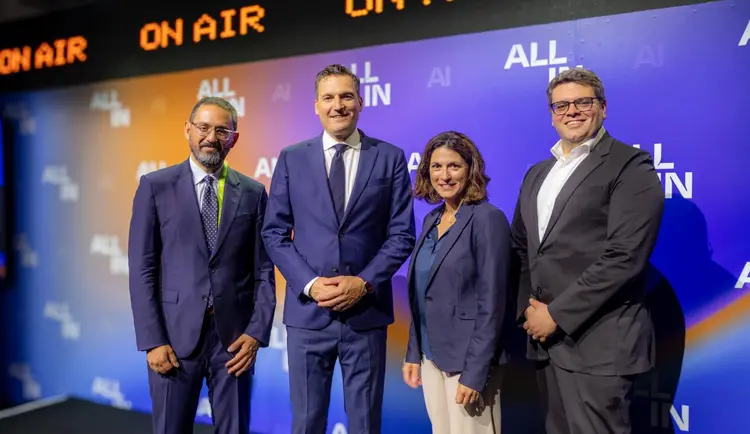
The promise of open AI often hits an unglamorous obstacle: installing a model is easy; making it work in production, with permissions, internal data, security, and predictable costs, is a different story. On September 17, 2026, at the ALL IN event in Montréal, Mila and Mozilla announced an attempt to close that gap: an open source foundation layer for organizations to run AI in their own environments.
Mozilla's announcement describes two components: an open standard, published as interface contracts, and a reference implementation that companies, public institutions, hospitals, small organizations, or governments can install on the machines they choose. The note distributed by Newswire adds the initial funding: $5 million from Mozilla and $1 million from Hypertec for early Canadian deployments.

Arguments in favour
The strongest side of the proposal is simple: many organizations want to use open models, but do not want to become infrastructure companies. According to Mozilla, the goal is to make "owning your AI" as easy as renting a closed service. That means choosing models, keeping data inside your own environment, applying governance, and swapping stack components without being locked into one provider.
The partnership also combines useful roles. Mila brings a community of close to 2,000 AI researchers and professionals; Mozilla brings experience in open infrastructure, standards, and developer ecosystems. BetaKit frames the initiative as a practical response to rising proprietary AI costs and the fact that many small teams cannot move from prototype to production.
Risks and limitations
The hard part is precisely the word "foundation". An open standard only becomes valuable when there are real implementations, documentation, maintenance, and compatibility across vendors. If the reference stack arrives too heavy, only large teams will operate it; if it arrives too simple, it may not solve security, integration, and observability, the points where AI projects often fail after the demo.
There is also a policy tension. Canadian government support turns the initiative into a case of technological sovereignty, but sovereignty does not replace technical quality. To compete with closed services from OpenAI, Anthropic, Google, or Cohere, the stack has to be easy to install, cheap to operate, and good enough for common tasks. Mozilla cites its State of Open Source AI report in the announcement: 79% of developers adding AI use open models, but only 53% of teams reach production. That is the number the initiative has to change.

Verdict
The announcement matters now because the open AI debate is no longer only about model weights. The more useful question is: who can turn those weights into a reliable, governable, installable tool for organizations that do not have a full MLOps team? Mila and Mozilla expect to publish reference implementations for enterprise, government, and public-interest use cases within six months, with a two-year ambition to make open source AI adoption much more direct.
If it works, the initiative could give small businesses, universities, municipalities, and nonprofits a more controllable alternative to pay-per-use services. If it fails, it will still show where the pain is: open AI does not only need good models; it needs packaging, contracts, updates, and operational trust. The value of the project is in that public test. It is not a new chatbot app, or another benchmark. It is an attempt to make open AI infrastructure feel less handmade and more inevitable.

lara654zz Sep 19, 2026 12:16 PM
o número de 79% é que me travou, não o título. Mozilla fica no centro disto e o resto do artigo parece contexto. alguém lê isto da mesma forma ou estou a puxar demais?..
danski110 Sep 19, 2026 9:09 AM
@renus66 hm — $5 million at Mozilla is the paragraph i'd fight over. what happens to your read if that number gets revised?
neokx860 Sep 18, 2026 6:23 PM
@renus66 não tenho a certeza de que seja isso que o post diz. Mila e Mozilla anunciaram no ALL IN, a 17 de setembro, uma camada fundacional open source para…. o ponto de ALL IN é que eu empurrava xd
renus66 Sep 18, 2026 10:37 AM
O lado forte da proposta é smples: muitas organizações querem usar modelos abertos, mas não querem transformar-se em empresas…. ok, mas depois aparece 79% e a escala muda. é essa figura que eu queria ver desmontada — o resto parece contexto à volta.