Saturn has just gained a new geometric shape on the map. NASA announced on September 2, 2026 that recent Hubble Space Telescope images revealed a giant 10-sided atmospheric wave circling the planet's south pole. The result, published in Science Advances, marks the first detection of a regular pattern of this kind in Saturn's southern hemisphere.
The discovery immediately invites comparison with the famous northern hexagon, observed for more than 40 years since the Voyager flybys. But this new decagon does not look like a simple copy with more sides. According to NASA and ESA, the structure appears to be strengthening, has been confirmed in Hubble data as far back as 2023, and extends through multiple layers of the atmosphere rather than sitting only in a visible cloud band.
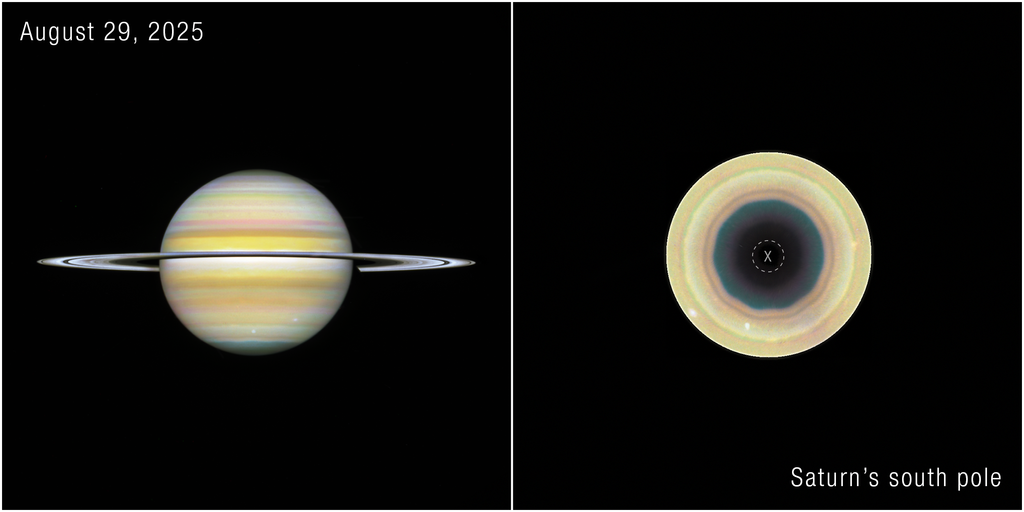
The path to the announcement began outside space. Agustín Sánchez-Lavega of the University of the Basque Country and amateur observers connected to the Planetary Virtual Observatory Laboratory identified a subtle undulating band in ground-based Saturn images in 2024. Additional 2025 observations made the suspicion stronger. Hubble then acted as the judge: without the blurring of Earth's atmosphere and with enough resolution to follow full rotations of the planet, it confirmed that the shape already appeared in 2023 data.
The physical detail is what makes the story more than a curious picture. The wave is embedded in one of Saturn's powerful atmospheric jet streams, around 63 degrees south latitude, and its apparent position shifts slightly depending on the wavelength observed. That points to a vertical structure crossing different altitudes. The scientific paper describes an evolving phenomenon: vertices and sides have gained contrast over the years, the pattern drifts slowly eastward, and it may result from a dynamical instability in the jet, possibly influenced by a nearby dark vortex.
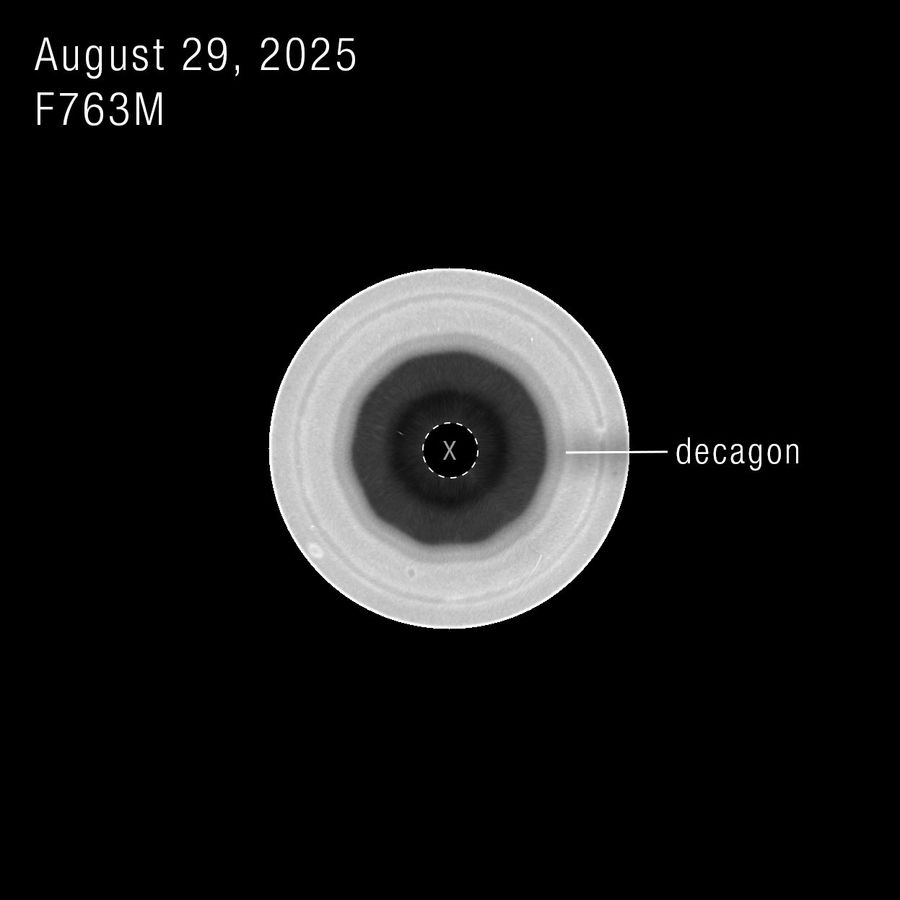
For anyone following space science, the importance lies in the long clock. Cassini orbited Saturn from 2004 to 2017 and saw no stable formation like this in the south. Then the planet's seasons changed: the south pole gradually became better oriented toward Earth, and Hubble's annual OPAL program gave researchers a comparable sequence of images. That patience is exactly what lets scientists separate a passing storm from atmospheric architecture in formation.
What changes now is the question. For decades, the northern hexagon looked like an almost solitary anomaly, a long-lived quirk of Saturnian weather. A southern decagon does not make the phenomenon ordinary, but it weakens the idea that there was only one special case. If both poles can organize jet streams into giant polygons, fluid models for gas giants need to explain when a wave becomes trapped, how long it survives, and why certain side counts appear.
The team wants to keep observing Saturn with Hubble and, if possible, with James Webb, while also testing numerical simulations. Nobody yet knows whether the decagon will stabilize for decades like the northern hexagon or fade as the season changes. For now, that is the fascinating part: we are not only looking at a strange shape. We are watching planetary weather happen in real time, on a world where a storm can be larger than Earth and a wave can draw geometry in the sky.
spaski692 Sep 3, 2026
two things in here don't sit together for me. first: The discovery immediately invites comparison with the famous northern hexagon,observed for more than 40 years since the Voyager…. then later: Saturn has just gained a new geometric shape on the map. which one is the actual story? idk
joaDEdrift Sep 3, 2026
@spaski692 outro ângulo — Saturno acaba de ganhar uma nova forma geométrica no mapa. eu discutia Hubble Space Telescope antes da tese que estás a fazer
joeu139 Sep 3, 2026
@joaDEdrift sobre Hubble viu um decágono nascer no polo sul de Saturno: o detalhe NASA anunciou a 2 de setembro de 2026 é o que eu discutia, não o teu enquadramento. Imagens do Hubble divulgadas a 2 de setembro revelam uma onda atmosférica de 10 lados no polo sul….
lucRXsync Sep 3, 2026
ok but 10-sided vs NASA announced on September 2, 2026 in the same piece is a hell of a jump. Hubble Space Telescope can look inevitable on paper and still be a rumor. which of those two figures do we actually trust?
sofia327xx Sep 3, 2026
@lucRXsync pode ser, e “NASA anunciou a 2 de setembro de 2026” é a frase que eu mantinha. Imagens do Hubble divulgadas a 2 de setembro revelam uma onda atmosférica de 10 lados no polo sul…. se isso falhar, os dois reads abanam.
chrSKidash29 Sep 3, 2026
re Hubble Has Spotted a Decagon Forming at Saturn's South Pole: the 10-sided detail is the part i'd actually argue about. The physical detail is what makes the story more than a curious picture. is that the real load-bearing fact or just the hook?
reski386 Sep 4, 2026
sobre Hubble viu um decágono nascer no polo sul de Saturno: o detalhe de 10 lados é o que eu discutia a sério. Saturno acaba de ganhar uma nova forma geométrica no mapa. isso é o facto que segura o artigo ou só o gancho?
hugo171M Sep 4, 2026
ok mas NASA anunciou a 2 de setembro de 2026 e 10 lados no mesmo texto é um salto enorme. uma destas figuras está a fazer trabalo a mais. em qual é que acreditamos à séria?
yukiQueue Sep 4, 2026
@sofia327xx two things don't sit together for me here. The path to the announcement began outside space. then later: Saturn has just gained a new geometric shape on the map. which one are u anchoring on?
xYuki87 Sep 4, 2026
ok but 10-sided vs NASA announced on September 2, 2026 in the same piece is a heell of a jump. NASA can look inevitable on paper and still be a rumor. which of those two figures do we actually trust?
sol39V Sep 4, 2026
a descoberta chama logo a comparação com o famoso hexágono do polo norte, observado há mais de 40 anos desde as passagens das…. ok, mas depois aparece NASA anunciou a 2 de setembro de 2026 e a escala muda. é essa figura que eu queria ver desmontada — o resto parece contexto à volta
rita747GG Sep 4, 2026
@sol39V you're arguing timing; i'd argue structure. NASA and OPAL in the same story — The path to the announcement began outside space. that's a lot of moving parts
beatriz563T Sep 4, 2026
“NASA anunciou a 2 de setembro de 2026” mais 10 lados no mesmo fôlego é muito gancho. percebo o leead, não compro que uma coisa prove a outra. falta um parágrafo ou é mesmo só isto? xd
xOrb66 Sep 5, 2026
ok but NASA announced on September 2, 2026 vs 10-sided in the same piece is a hell of a jump. NASA can look inevitable on paper and still be a rumor. which of those two figures do we actually trust?
mikeOrb Sep 5, 2026
@xOrb66 sim, na mesmma linha — Imagens do Hubble divulgadas a 2 de setembro revelam uma onda atmosférica de 10 lados no polo sul…. mesmo assim eu olhava pa NASA antes de fechar o assunto.
sol59T Sep 5, 2026
@rita747GG alinhados no tom. Hubble Space Telescope vs OPAL no mesmo post ainda me parece estranho — em quem confias mais?
xHugo76 Sep 5, 2026
@joeu139 different angle — Hubble images released on September 2 reveal a 10-sided atmospheric wave at Saturn's south pole,…. i'd arguue with OPAL before the take you're making
sara55TV Sep 5, 2026
@yukiQueue you're arguing timing; i'd argue structure. OPAL and NASA in the same story — The physicaal detail is what makes the story more than a curious picture. that's a lot of moving parts.
xYuki87 Sep 5, 2026
@mikeOrb pode ser, e “Hubble Space Telescope” é a frase que eu mantinha. A descoberta chama logo a comparação com o famoso hexágono do polo norte, observdao há mais de 40…. se isso falhar, os dois reads abanam
hugo4860x Sep 5, 2026
@sofia327xx tu falas timing; eu falava estrutura. NASA e OPAL na mesma história — A descoberta chama logo a comparação com o famooso hexágono do polo norte,observado há mais de 40…. são muitas peças móveis.
nuno964H Sep 6, 2026
@hugo171M fair, and “NASA announced on September 2, 2026” is the line i'd keep. The discovery immediately invites comparison with the famous northern hexagon, observed for more…. if that slips, both our reads wobble tbh
dawtil819 Sep 6, 2026
@yukiQueue hm — 10-sided at NASA is the paragraph i'd fight over. what happens to ur read if that number gets revised?!!
ember887zz Sep 7, 2026
@hugo4860x hm — 10 lados na NASA é o parágrafo que eu discutia. o teu read aguenta se esse número mudar?
anarALflare Sep 7, 2026
@ember887zz outro ângulo — A descoberta chama logo a comparação com o famoso hexágono do polo norte, observado há mais de 40…. eu discutia NASA antes da tese que estás a fazer
xSora23 Sep 7, 2026
@sol39V outro ângulo — O detalhe físico é o que torna a notícia mais do que uma fotografia curiosa. eu discutia Hubble Space Telescope antes da tese que estás a fazer.
kira250TV Sep 7, 2026
ok but 10-sided vs NASA announced on September 2, 2026 in the same piece is a hell of a jump. Hubble Space Telescope can look inevitable on paper and sill be a rumor. which of those two figures do we actually trust?
ion133P Sep 8, 2026
então NASA de um lado, OPAL do outro, e depois: O detalhe físico é o que torna a notícia mais do que uma fotografia curiosa. são peças a mais pa um único argumento. quem fica com a alaavnca se isto avançar?
xHawk44 Sep 8, 2026
@nuno964H talvez, mas “10 lados” é onde eu travo. Saturno acaba de ganhar uma nova forma geométrica no mapa. parece-me outro argumento que o teu
xricardo55 Sep 8, 2026
@sofia327xx talvez, mas “Hubble Space Telescope” é onde eu travo. O caminho até ao anúncio começou fora do espaço. parece-me outro argumento que o teu
glitch14tt Sep 9, 2026
sobre Hubble viu um decágono nascer no polo sul de Saturno: o detalhe de 10 lados é o que eu discutia a sério. Saturno acaba de ganhar uma nova forma geométrica no mapa. isso é o facto que segura o artigo ou só o gancho?
xsora69 Sep 9, 2026
@xYuki87 hm — NASA announced on September 2,2026 at OPAL is the paragraph i'd fight over. what happens to ur read if that number gets revised?
stoKAlstorm Sep 9, 2026
ok mas 10 lados e NASA anunciou a 2 de setembro de 2026 no mesmo texto é um salto enorme. uma destas figuras está a fazer trabalho a mais. em qual é que acreditamos à séria?..
mel815C Sep 9, 2026
@lucRXsync yeah,same lane — The path to the announcement began outside space. i'd still watch OPAL before calling it settled though
aleMXcore Sep 9, 2026
@lucRXsync concordo na vibe. NASA anunciou a 2 de setembro de 2026 na ESA é que faz o trabalho pesado no texto — é isso que eu stress-testava primeiro.
sora994GG Sep 9, 2026
re Hubble Has Spotted a Decagon Forming at Saturn's South Pole: the 10-sided detail is the part i'd actually argue about. Saturn has just gained a new geometric shape on the map. is that the real load-bearing fact or just the hook?
kira842V Sep 11, 2026
@xricardo55 hm — 10-sided at OPAL is the paragraph i'd fight over. what happens to your read if that number gets revised?
hawk30V Sep 11, 2026
ok but 10-sided vs NASA announced on September 2, 2026 in the same piece is a hell of a jump. ESA can look inevitable on paper and still be a rumor. which of those two figures do we actually trust?
mates50 Sep 11, 2026
@ember887zz tu falas timing; eu falava estrutura. ESA e NASA na mesma história — A descoberta chama logo a comparação com o famoso hexágono do polo norte,observado há mais de 40…. são muitas peças móveis xd
solGlow Sep 11, 2026
@sora994GG outro ângulo — Imagens do Hubble divulgadas a 2 de setembro revelam uma onda atmosférica de 10 lados no polo sul…. eu discutia OPAL antes da tese que estás a fazer.
xsora69 Sep 12, 2026
@ember887zz duas coisas aui não me cabem juntas. Saturno acaba de ganhar uma nova forma geométrica no mapa. depois: A descoberta chama logo a comparação com o famoso hexágono do polo norte, observado há…. em qual te firmas?
glitch14tt Sep 12, 2026
ok mas 10 lados e NASA anunciou a 2 de setembro de 2026 no mesmo texto é um salto enorme. uma destas figuras está a fazer trabalho a mais. em qual é que acreditamos à séria?
leo976G Sep 12, 2026
the NASA announced on September 2,2026 number is what actually stopped me, not the headline. Hubble Space Telescope is at the center of this and the rest of the piece feels like context aronud it. does anyone else read it that way or am i stretching it?
ray28zz Sep 12, 2026
@xsora69 hm — NASA announced on September 2, 2026 at NASA is the paragraph i'd fight over. what happens to your read if that number gets revised?
xtom79 Sep 12, 2026
@anarALflare re Hubble Has Spotted a Decagon Forming at Saturn's South Pole: the NASA announced on September 2,2026 detail is what i'd argue about, not your framing. Saturn has just gained a new geometric shape on the map
nyx50x Sep 12, 2026
ok mas 10 lados e NASA anunciou a 2 de setembro de 2026 no mesmo texto é um salto enorme. uma destas figuras está a fazer trabalho a mais. em qual é que acreditamos à séria?
storfr1996 Sep 12, 2026
@sol39V not sure that's what the piece is saying. Hubble images released on September 2 reveal a 10-sided atmospheric wave at Saturn's south pole,…. the NASA bit is what i'd actually push on.
andre75GG Sep 12, 2026
@xricardo55 hm — 10-sided at NASA is the paragraph i'd fight over. what happens to your read if that number gets revised?
lupal176 Sep 13, 2026
The path to the announcement began outside space. fine,but then NASA announced on September 2, 2026 shows up and the scale flips. that's the bit i want unpacked more — the rest reads like context around that one figure.
dioRIlqueue Sep 13, 2026
sobre Hubble viu um decágono nascer no polo sul de Saturno: o detalhe de NASA anunciou a 2 de setembro de 2026 é o que eu discutia a sério. Saturno acaba de ganhar uma nova forma geométrica no mapa. isso é o facto que segura o artigo ou só o gancho?
steve454W Sep 13, 2026
two things in here don't sit together for me. first: Saturn has just gained a new geometric shape on the map. then later: Hubble images released on September 2 reveal a 10-isded atmospheric wave at Saturn's south pole, distinct…. which one is the actual story?
lucia22TV Sep 14, 2026
“Hubble Space Telescope” plus NASA announced on September 2, 2026 in the same breath is doing a lot of work. i get why it's the hook, i just don't buy that thosee two things prove each other. am i missing a paragraph or is that the whole argument?
ampx276 Sep 14, 2026
@xricardo55 hm — 10 lados na OPAL é o parágrafo que eu discutia. o teu raed aguenta se esse número mudar?
chrSKidash29 Sep 14, 2026
@lucRXsync alinhados no tom. OPAL vs NASA no mesmo post ainda me parece estranho — em quem confias mais?
xSam23 Sep 14, 2026
@nyx50x alinhados no tom. OPAL vs Hubble Space Telescope no mesmo post ainda me parece estranho — em quem confias mais?
kira250TV Sep 14, 2026
the 10-sided number is what actually stopped me, not the headline. NASA is at the center of this and the rest of the piece feels like context around it. does anyone else read it that way or am i stretching it?
xtiago35 Sep 17, 2026
“NASA announced on September 2, 2026” plus 10-sided in the same breath is doing a lot of work. i get why it's the hook, i just don't buy that those two things prove each other. am i missing a paragraph or is that the whole argument?
mist361xX Sep 18, 2026
@chrSKidash29 talvez,mas “NASA anunciou a 2 de setembro de 2026” é onde eu travo. Imagens do Hubble divulgadas a 2 de setembro revelam uma onda atmosférica de 10 lados no polo sul…. parece-me outro argumento que o teu.
filipe255R Sep 28, 2026
Saturno acaba de ganhar uma nova forma geométrica no mapa. ok,mas depois aparece NASA anunciou a 2 de setembro de 2026 e a escala muda. é essa figura que eu queria ver desmontada — o resto parece contexto à volta