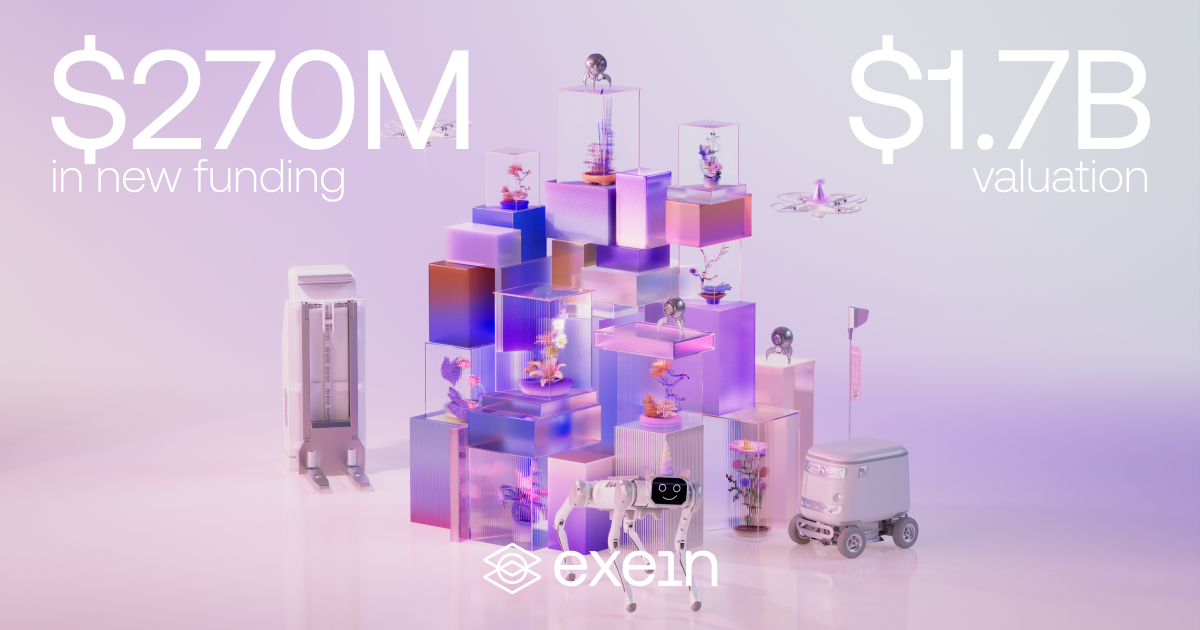
- The short version: Exein raised $270 million and reached a $1.7 billion valuation, becoming one of Europe's newest cybersecurity unicorns.
- The focus: securing Physical AI, meaning machines that use AI to perceive, decide, and act in the real world.
- The risk: when a robot, vehicle, drone, or industrial system is compromised, the problem can move beyond data loss into physical action.
- The timing: the round lands as European Cyber Resilience Act reporting obligations begin to matter more for manufacturers.
The word "unicorn" often hides more than it reveals. In Exein's case, though, the new valuation points to a real market shift: cybersecurity is moving from laptops, servers, and cloud consoles into firmware, kernels, and systems that move objects in the physical world. The Italian company announced on September 15, 2026 that it had raised $270 million, led by Headline, to accelerate expansion in the United States and Asia-Pacific.
In the official announcement, Exein frames its mission as building the security layer for robots, drones, vehicles, and other machines that use AI to act in the physical world. TechCrunch put the thesis simply: the startup started in IoT, but is now trying to ride the Physical AI wave. The European Investment Bank also confirmed group participation through the ETCI initiative, presenting the deal as a case study in European technology scale-up financing.
Why Physical AI changes the risk map
For years, insecure IoT meant cameras, routers, sensors, and industrial equipment that were poorly updated. That still matters, but the new layer is more demanding: many of those devices are starting to run models, make local decisions, and respond to the environment without waiting for a human operator. Exein calls this Physical AI. It is not just AI observing the world; it is AI attached to motors, production lines, hospitals, power grids, and cars.
That transition makes the old security question more concrete. If an online service is attacked, it can lose data or go offline. If an intelligent machine is attacked, it can brake at the wrong time, accept false commands, degrade equipment, or interfere with critical processes. Gianni Cuozzo, Exein founder and CEO, says attacks already happen at "machine speed"; defense, he argues, has to respond on the same clock.

The money buys expansion, but also a race to define the standard
The investor list shows that Exein wants more than a flashy round. Alongside Headline, participants include Sofina, Goldman Sachs, EIB Group, KfW Capital, and T.Capital, with existing investors such as Balderton, HV, Lakestar, and 33N Ventures. The company says the capital will support growth in the United States, a stronger APAC presence, Japanese expansion, a future South Korea office, and acquisitions.
The strategic detail is the ambition to become a standard before the category hardens. Exein says it protects more than two billion connected devices and is training a proprietary foundation model for Physical AI security on two years of machine telemetry. The stated goal is to power autonomous security agents that understand normal machine behavior on the systems where they run and react without waiting for human triage.

Europe wants champions, manufacturers want proof
There is also a policy reading. The EIB described its participation as the first direct co-investment by the European Tech Champions Initiative into a company, a signal that Brussels wants funds able to support large rounds without pushing promising scale-ups out of Europe. For a company headquartered in Rome, with operations across Europe, Asia-Pacific, and the United States, that narrative matters: industrial cybersecurity, technological sovereignty, and regulation now sit inside the same conversation.
The market, however, will not accept the narrative alone. Manufacturers in automotive, semiconductors, medical equipment, energy, and industrial automation will demand clean integration, low latency, compliance evidence, and predictable costs. The promise of security inside firmware is powerful precisely because it sits close to the machine; that also makes it hard to sell, test, and maintain across long supply chains.
The news matters now because AI is gaining wheels, arms, and sensors faster than traditional security processes can keep up. Exein may not be the only answer, but the round shows that investors and European institutions already treat Physical AI security as its own category. When the next generation of intelligent machines reaches the field, the question will no longer be only which model runs inside. It will be who makes sure it does not become a moving attack surface.
shaPXcrit Sep 16, 2026 10:19 AM
ok but 1.7 billion vs September 15, 2026 in the samme piece is a hell of a jump. The short version can look inevitable on paper and still be a rumor. which of those two figures do we actually trust?!!
stoKAlstorm Sep 16, 2026 9:05 AM
a parte de “Porque Physical AI muda o mapa do risco” é que importa. Essa transição torna a vlha pergunta sobre segurança mais concreta. não me parece que isto siga tão linear quanto está escrito. e se essa premissa falhar? xd