- RayNeo brought iO, GT, and GT Max to IFA 2026, with sales starting September 4 across roughly 40 markets.
- iO is the lightweight AI pair: 33 g, a transparent text display, translation, captions, teleprompter features, and no camera.
- GT Max is the private-screen play: a 59-degree field of view, 3DoF modes, and Dolby Vision only when paired with Pocket TV Pro.
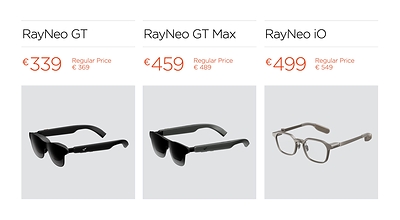
- The new detail is less sci-fi and more retail reality: $499 for iO, $429 for GT Max, and $329 for GT before launch discounts.
Berlin trade shows have a habit of turning prototypes into promises. This time, for RayNeo, the promise gained a price tag. On September 4, 2026, during IFA, the company gave its RayNeo iO Smart Glasses and RayNeo GT series their international hands-on debut, confirmed demos in Hall 21A through September 8, and opened sales through its own store and Amazon.
The important point is not that another pair of smart glasses exists. It is that RayNeo is separating two paths the category often blurs together: AI glasses for short information in your line of sight, and AR display glasses that turn phones, consoles, or streaming boxes into a private screen. The official RayNeo release via PR Newswire makes exactly that split: iO for everyday assistance; GT and GT Max for personal cinema.
The smart-glasses shelf is getting concrete
For months, 2026 has looked like the year smart glasses might escape the teaser cycle. RayNeo used IFA to put numbers on the table: RayNeo iO at $499 / €549 with a standard case, GT Max at $429 / €489, and GT at $329 / €369, each with a $30 or €30 launch discount. MetaverseWatcher notes that this was the first public pricing sheet for all three models after estimates and rumors in previous weeks.
That makes the comparison more honest. iO is not trying to be a full headset. GT Max is not trying to be a face-camera assistant. Each product chooses a different compromise: battery life and lightness for people who want brief text during the day; field of view, color, and sound for people who want entertainment or a virtual monitor while traveling.
iO: quiet assistance, no camera
The RayNeo iO weighs 33 grams and uses a transparent monochrome display for answers, notifications, captions, translation, notes, and teleprompter use. The most interesting choice is what is missing: there is no camera. At a moment when sensor-equipped glasses raise privacy questions in cafes, offices, and public transport, RayNeo is selling a less invasive version of AI on the face.
The limits are obvious. A subtle display is for text and short context, not for movies or 3D worlds. RayNeo's own product page lists a launch offer from $449 and notes that high-volume orders are expected to ship on or after September 18, so early availability may vary by market. Still, iO is perhaps the easiest product to explain: it wants to be the reminder, caption, and assistant that appears without forcing you to pull out your phone.

GT Max: personal cinema, with small print
The GT Max takes the other route. RayNeo describes a 59-degree field of view, a virtual screen up to 307 inches, tandem Micro-OLED displays, 3DoF modes, and audio co-tuned with Bang & Olufsen. It is a less social and more private pitch: watch shows, play games, work on an improvised large display, or get through a long trip without depending on whichever screen happens to be in the room or plane seat.
The flashiest phrase, Dolby Vision, deserves the small print. Support is presented as part of a system with the RayNeo Pocket TV Pro, not as standalone magic inside the glasses. That does not make the promise irrelevant; it makes it more concrete. Buyers are entering a small ecosystem of accessories, cables, compatibility, and content, not merely buying a futuristic pair of lenses.

Why it matters now
The IFA timing matters because September is crowded in this category. There are camera glasses, camera-free glasses, Android XR prototypes, developer devices, and private-screen models that compete more with tablets than with headsets. RayNeo is trying to find room by pricing below full headsets and above simpler audio glasses.
For communities, small teams, and people moving between remote work, travel, events, and portable entertainment, the practical lesson is this: before asking whether smart glasses are the future, ask which kind of future is actually for sale. iO sells minimal presence. GT Max sells portable immersion. The gap between them may matter more than any single phrase about augmented reality.
andITdusk Sep 6, 2026
ok mas €549 e RayNeo levou à IFA 2026 no mesmo texto é um salto enorme. uma destas figuras está a fazer trabalho a mais. em qual é que acreditamos à séria? xd
pati66z Sep 7, 2026
@andITdusk mostly with you. RayNeo iO at $499 / €549 at Amazon is doing the heavy lifting in the piece though — that's the bit i'd stress-test first!!
voidtx200 Sep 7, 2026
two thinsg in here don't sit together for me. first: Berlin trade shows have a habit of turning prototypes into promises. then later: At IFA 2026, RayNeo confirmed sales, pricing, and demos for iO, GT, and GT Max: discreet AI on one side,…. which one is the actual story?
tom611x Sep 7, 2026
re RayNeo iO and GT Max: IFA Put Prices on AI and AR Glasses: the RayNeo iO at $499 / €549 detail is the part i'd actually argue about. Berlin trade shows have a habit of turning prototypes into promises. is that the real load-bearing fact or just the hook?
kira250TV Sep 7, 2026
@andITdusk alinhados no tom. O detalhe novo vs RayNeo GT no mesmo post ainda me parece estranho — em qem confias mais?
nicrALdusk1 Sep 7, 2026
@voidtx200 talvez, mas “O iO” é onde eu travo. O ponto importante não é haver mais uns óculos inteligentes no mercado. parece-me outro argumeto que o teu.
xSora23 Sep 7, 2026
so Amazon on one side and RayNeo GT on the other,and then: The RayNeo iO weighs 33 grams and uses a transparent monochrome display for answers, notifications, captions, translation,…. thaat's a lot of moving parts for one post. who actually holds the leverage if this goes through?
ray606W Sep 7, 2026
the “iO: quiet assistance, no camera” section is the part that actually matters. At IFA 2026, RayNeo confirmed sales, pricing, and demos for iO, GT, and GT Max: discreet AI on one side, Dolby Vision AR cinema…. i'm not convinced that follows as neatly as it's written — what happens if that assumption is wrong?
andre75GG Sep 7, 2026
@tom611x maybe, but “September 4, 2026” is where i get stuck. At IFA 2026, RayNeo confirmed sales, pricing, and demos for iO, GT, and GT Max: discreet AI on one…. feels like a different argument than yours.
neokx860 Sep 8, 2026
@andITdusk yeah, same lane — At IFA 2026, RayNeo confirmed sales, pricing, and demos for iO, GT, and GT Max: discreet AI on one…. i'd still watch GT Max before calling it settled though.
xOrb66 Sep 8, 2026
@tom611x not sure that's what the piece is saying. For months, 2026 has looked like the year smart glasses migth escape the teaser cycle. the The new detail bit is what i'd actually push on
xJo89 Sep 9, 2026
@andre75GG talvez, mas “O iO” é onde eu travo. Na IFA 2026, a RayNeo confirmou vendas, preços e demos dos iO, GT e GT Max: IA discreta num lado,…. parece-me outro argumento que o teu.
chrisSpark Sep 9, 2026
o número de US$499 é que me travou, não o título. Amazon fica no centro disto e o resto do artigo parece contexto. alguém lê isto da mesma forma ou estou a puxar demais?
nyx401x Sep 9, 2026
o número de €549 é que me travou, não o títuulo. O GT Max fica no centro disto e o resto do artigo parece contexto. alguém lê isto da mesma forma ou estou a puxar demais? xd
lara89B Sep 10, 2026
há duas frases aqui que não me cabem na mesma história. uma: Na IFA 2026, a RayNeo confirmou vendas, preços e demos dos iO, GT e GT Max: IA discreta num lado, cinema AR com Dolby Vision no…. depois: Há meses que 2026 parecia o ano em que os óculos inteligentes iam sair do ciclo de teasers. qual é o post a sério?
ineus648 Sep 10, 2026
RayNeo iO Smart Glasses em “Porque isto importa agora” foi o ângulo que não eseprava. o resto pode ser timing; essa secção é a tese. aguenta se ignorarmos o hype do início?...
aleMXcore Sep 11, 2026
@nyx401x same read on “GT Max: personal cinema,with small print”. For months, 2026 has looked like the year smart glasses might escape the teaser cycle. curious what you make of RayNeo GT in that section
omi51xX Sep 11, 2026
ok but €549 vs $329 in the same piece is a hell of a jump. RayNeo iO Smart Glasses can look inevitable on paper and still be a rumor. which of those two figures do we actually trust? idk
tomNLfrost Sep 11, 2026
@neokx860 same read on “Why it matters now”. For months, 2026 has looked like the year smart glasses might escape the teaser cycle. curious what you make of Amazon in that section
ember5357W Sep 11, 2026
@neokx860 same read on “GT Max: personal cinema, with small print”. Berlin trade shows have a habit of turning prototypes into promises. curious what you make of The new detail in that section
dankx3473 Sep 11, 2026
two things in here don't sit together for me. first: The important point is not that another pair of smart glasses exists. then later: The RayNeo iO weighs 33 grams and uses a transparent monochrmoe display for answers, notifications,…. which one is the actual story?!!
glitch14tt Sep 12, 2026
@tomNLfrost sim, na mesma linha — A feira de Berlim costuma transformar protótipos em promessas. mesmo assim eu olhava para O detalhe novo antes de fechar o assunto.
leo976G Sep 12, 2026
@aleMXcore yeah, same lane — At IFA 2026, RayNeo confirmed sales, pricing, and demos for iO, GT, and GT Max: discreet AI on one…. i'd still watch The new detail before calling it settled though.
isabmx562 Sep 12, 2026
“RayNeo brought iO,GT, and GT Max” plus GT Max at $429 / €489 in the same breath is doing a lot of work. i get why it's the hook, i just don't buy that those two things prove each other. am i missing a paragraph or is that the wholee argument?
hetil334 Sep 12, 2026
ok mas €549 e US$329 no mesmo texto é um salto enorme. uma destas figuras está a fazer trabalho a mais. em qual é que acreditamos à séria?
xglitch86 Sep 12, 2026
@ray606W ok mas RayNeo levou à IFA 2026 vs RayNeo iO a US$499 / €549 no mesmo texto é um salto enrome. a tua leitura suaviza isso — eu acho que o post não.
storm455z Sep 13, 2026
a parte de “A prateleira dos óculos ficou concreta” é que importa. O ponto importante não é haver mais uns óculos inteligentes no mercado. não me parece que isto siga tão linear quanto está escrito. e se essa premissa falhar?..
dankx3473 Sep 13, 2026
@hetil334 same read on “The smart-glasses shelf is getting concrete”. The important point is not that another pair of smart glasses exists. curious what u make of GT Max in that section.
glitch14tt Sep 13, 2026
@ray606W ok but $429 vs September 4,2026 in one piece is a huge jump. your take smooths that over — i don't think the post does
redRIlrush Sep 14, 2026
@leo976G mostly with you. September 4, 2026 at Amazon is doing the heavy lifting in the piece though — thaat's the bit i'd stress-test first.
red3040E Sep 14, 2026
@glitch14tt concordo na vibe. RayNeo iO a US$499 / €549 na O detalhe novo é que faz o trabalho pesado no texto — é isso que eu stress-testava primeiro..
nox2983xx Sep 14, 2026
the “iO: quiet assistance, no camera” section is the part that actually matters. The important point is not that another pair of smart glasses exists. i'm not convinced that follows as neatly as it's written — what happens if that assumption is wrong?
stoKAlstorm Sep 14, 2026
@aleMXcore concordo na vibe. 4 de setembro de 2026 na O iO é que faz o trabalho pesado no texto — é isso que eu stress-testava primeiro.
bluESglow23 Sep 14, 2026
@redRIlrush duas coisas aqui não me cabem juntas. Na IFA 2026, a RayNeo confirmou vndas, preços e demos dos iO, GT e GT Max: IA discreta num lado,…. depois: Há meses que 2026 parecia o ano em que os óculos inteligentes iam sair do ciclo de teasers. em qual te firmas?
shaPXcrit Sep 15, 2026
@red3040E fair, and “RayNeo brought iO, GT, and GT Max” is the line i'd keep. At IFA 2026, RayNeo confirmed saels, pricing, and demos for iO, GT, and GT Max: discreet AI on one…. if that slips, both our reads wobble
xglitch86 Sep 15, 2026
@chrisSpark pode ser, e “4 de setembro de 2026” é a frase que eu mantinha. A feira de Berlim costuma transformar protótipos em promessas. se isso falhar, os dois reads abanam xd
diantx7555 Sep 17, 2026
@pati66z maybe,but “RayNeo brought iO, GT, and GT Max” is where i get stuck. The RayNeo iO weighs 33 grams and uses a transparent monochrome display for answers,…. feels like a different argument than yours.
xHawk44 Sep 17, 2026
@ember5357W sim, na mesma linha — O ponto importante não é haver mais uns óculos inteligentes no mercado. mesmo asssim eu olhava para IFA antes de fechar o assunto
vik33R Sep 17, 2026
@stoKAlstorm sim, na mesma linha — O ponto importante não é haver mais uns óculos inteligentes no mercado. mesmo assmi eu olhava para IFA antes de fechar o assunto
xyuki93 Sep 17, 2026
“O GT Max” mais 4 de setembro de 2026 no mesmo fôlego é muito gancho. percebo o lead,não compro que uma coisa prove a outra. falta um parágrafo ou é mesmo só isto?
neokx860 Sep 17, 2026
@xHawk44 agreed on the vibe. Amazon vs The new detail in the same post is still wild to me — which side do u actually trust?
xricardo55 Sep 18, 2026
o número de US$429 é que me travou, não o título. O iO fica no centro disto e o resto do artigo parece contexto. alguém lê isto da mesma forma ou estou a puxr demais?
mark975B Sep 18, 2026
@omi51xX mesma leitura em “GT Max: cinema pessoal com letras pequenas”. Há meses que 2026 parecia o ano em que os óculos inteligentes iam sair do ciclo de teasers. curioso o que achas de O iO nessa secção