- The short version: Databricks acquired Row Zero on September 24, 2026 to bring live, governed spreadsheets into Genie.
- Why it matters: the company wants AI agents to meet finance, sales, and operations teams where much of their daily work still happens.
- The risk: turning the spreadsheet into an AI interface may help business users, but it also raises the stakes for auditability, permissions, and trust in data.
The spreadsheet has survived almost every promise to replace it. Dashboards tried to contain it, notebooks tried to educate it, internal apps tried to hide it. Still, when a team needs to model margin, forecast pipeline, or debate an exception, someone opens a grid. The news on September 24, 2026 is that Databricks has stopped treating that habit as a problem and bought into it: the company announced the acquisition of Row Zero, a startup that describes itself as a spreadsheet for modern cloud data.
In its official announcement, Databricks says Row Zero will be integrated into Genie, its AI coworker for business teams. The promise is familiar and ambitious: natural-language questions, enterprise data at scale, spreadsheet-style collaboration, and a governance layer built on Genie Ontology, Unity Catalog, and Unity Gateway. In other words, the company wants AI to answer, but also wants users to manipulate the numbers without leaving a structure they already understand.
The old interface got a new job
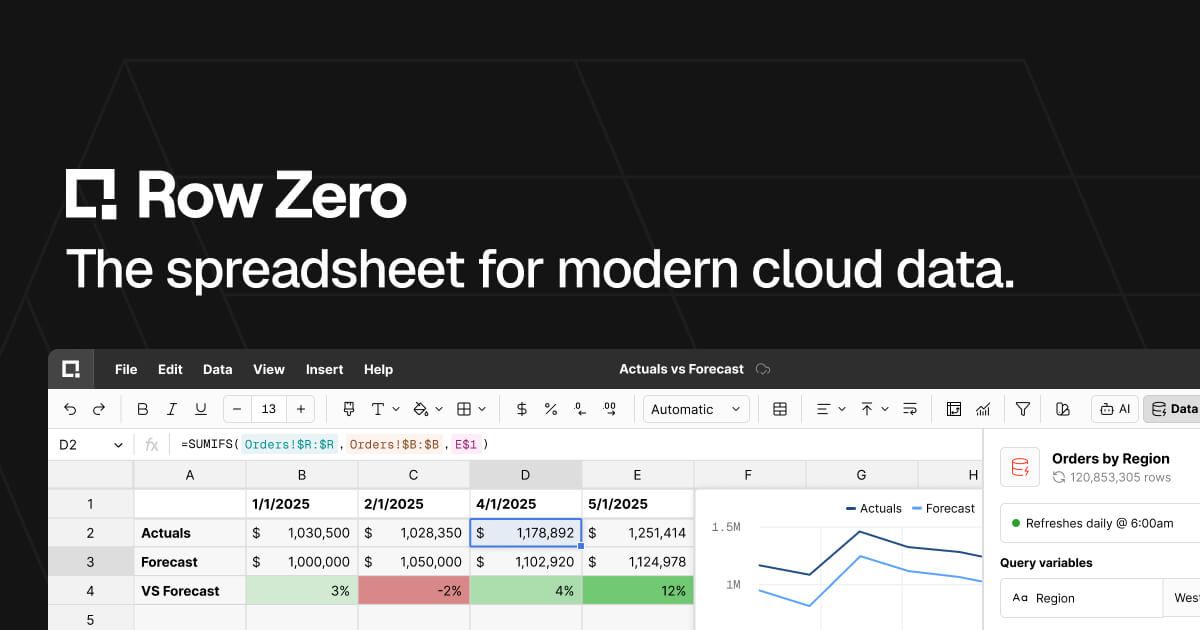
The interesting detail is not only the purchase of a startup. It is the choice of interface. Row Zero was founded by former AWS and Tableau engineers and promises to work with large volumes of data without forcing business teams to replace the spreadsheet with an unfamiliar tool. Databricks says the product will continue to support data sources beyond its own ecosystem and will become available to customers across all major clouds.
TechCrunch adds financial and strategic context: Row Zero raised $10 million in May 2025 at an estimated $40 million valuation, and Databricks has been buying aggressively this year. After acquisitions tied to agents, local databases, and security, a governed spreadsheet looks less mundane than it sounds. It is an entry point for users who do not only want to chat with a bot; they want to see, change, and defend an analysis.
What Databricks is really buying
The deal is a bet on the point of contact, not only on technology. Many data platforms can already store, clean, and query information. The problem sits in the last mile: helping non-technical teams trust the answer, adjust scenarios, and explain decisions without exporting everything into a local spreadsheet that breaks governance, lineage, and access control.
With Row Zero inside Genie, Databricks is trying to close that loop. A user could ask why margin changed, have the agent summarise the drivers, open a live sheet, adjust assumptions, and share the analysis without leaving the governed context. If it works, the spreadsheet changes from a loose file into an operating surface for enterprise agents.

The less shiny side of the AI grid
There is an obvious tension: the more powerful the spreadsheet becomes, the more dangerous it is to pretend it is simple. Agents can suggest formulas, change scenarios, pull sensitive data, and produce persuasive explanations even when the original question is poorly framed. Inside a company, the error is not only a wrong cell; it can become a financial forecast, hiring decision, commercial discount, or risk assessment.
That is why the boring part of the announcement may be the most important. Auditability, permissions, data catalogues, and shared context are not extras designed to impress CIOs. They are the difference between a good demo and a tool that can live inside a real enterprise budget. Databricks is not only buying a better spreadsheet. It is trying to stop the next generation of enterprise agents from ending up glued to exports, copies, and files named final_v7.
The timing explains the urgency. Databricks recently closed a $5 billion funding round and, according to TechCrunch, reached a $7 billion annualised revenue run rate. At that scale, every interface that keeps users inside the platform matters. Row Zero may look like a small piece, but it lives exactly where decisions happen: the grey zone between official data, human judgement, and the grid everyone still knows how to click.
Comments (0)
No comments yet.