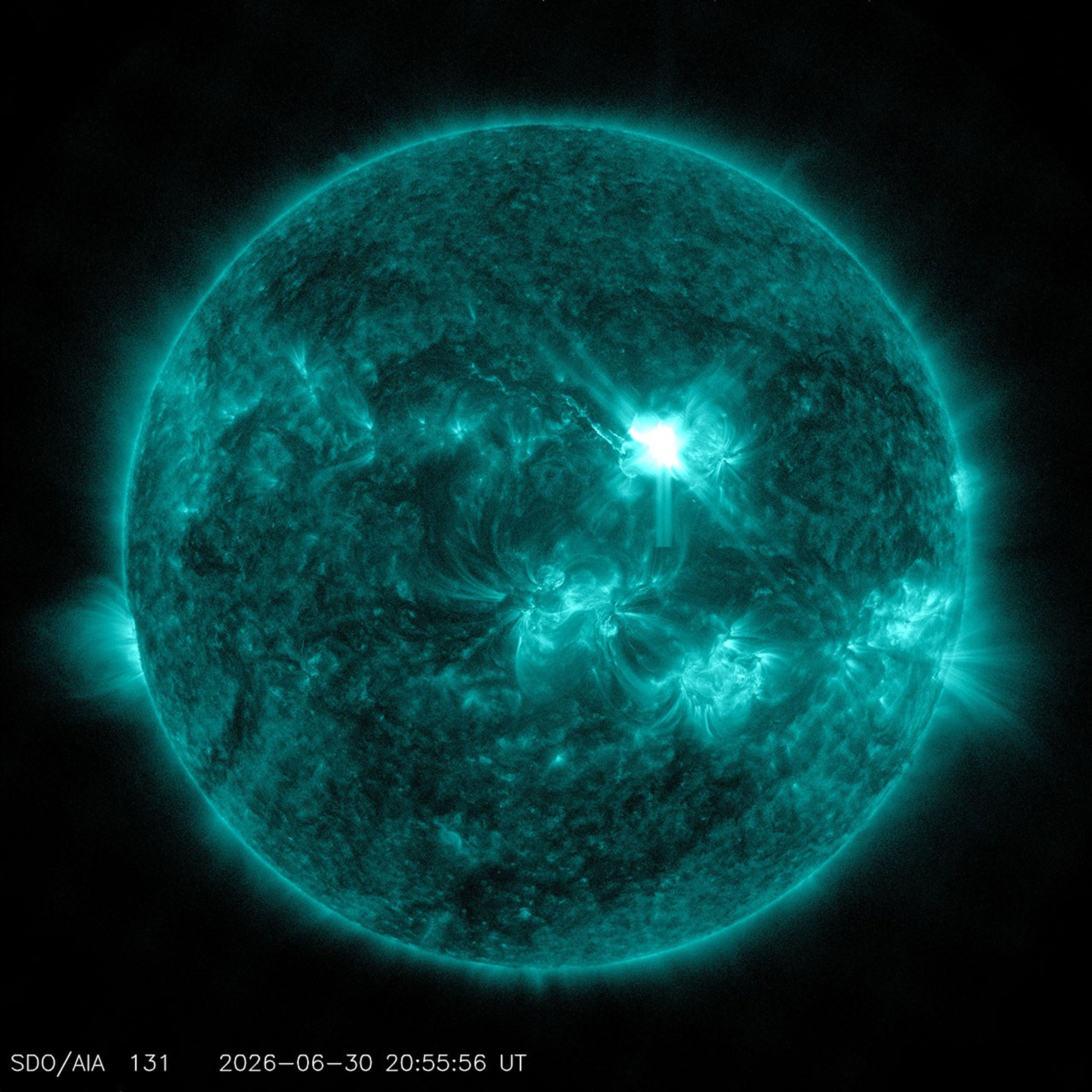
Before a sunspot appears, the Sun is already moving beneath the surface. The news NASA highlighted on August 14, 2026 is that a team at the COFFIES center says it has found a way to detect that motion in advance: a machine-learning model able to predict the emergence of solar active regions up to 12 hours before they become visible.
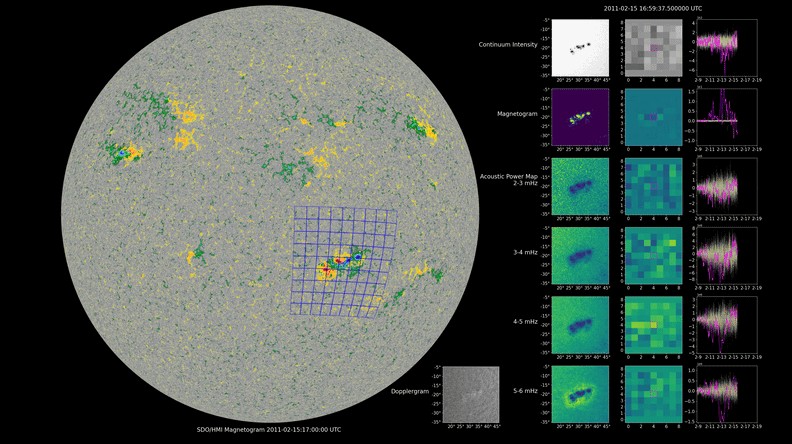
The full project name, Consequence Of Fields and Flows in the Interior and Exterior of the Sun, explains the ambition. This is not merely about looking at sunspots that have already formed, as traditional operational forecasts often do. The team brought together researchers from the New Jersey Institute of Technology, Princeton, and NASA Ames to analyze data from the Solar Dynamics Observatory and search for weak signals in acoustic waves and magnetic fields while the structure is still rising through the solar interior.
Arguments in favor
The promise is simple and enormous: gaining hours. Solar active regions are the engines behind solar flares and coronal mass ejections, events that can affect satellites, radio communications, power grids, and crewed missions. If a system can say where a dangerous region is likely to emerge before it is visible, space-weather centers stop reacting only to visible clues and start working with extra margin.
The technical detail is also interesting because it avoids the caricature of AI as magic. According to NASA, the model uses a sliding-window transformer architecture: instead of trying to swallow the whole Sun at once, it moves a window across long time sequences and looks for small reductions in acoustic power and magnetic changes that precede sunspot formation. EurekAlert, citing the study published in the Journal of Geophysical Research: Machine Learning and Computation, identifies the model as EarlyDetect and reports an average lead time of 9.24 hours in the best tests.
There is also a human reason to care. Space weather stopped being a niche topic once society became dependent on satellite constellations, GPS navigation, global internet links, and Artemis-era exploration. Earlier warning does not prevent the Sun from erupting, but it can help operators protect instruments, adjust maneuver windows, change extravehicular activity plans, or prepare backup communications.
Risks and limitations
NASA itself is clear: this is not yet a real-time operational tool. The model needs to be validated against many more solar events before it can enter workflows used by NASA, NOAA, the United States Air Force, or teams protecting astronauts. In applied science, a good historical result is only the beginning; the hard question is how the system behaves when solar activity changes, when data arrives incomplete, or when the forecast fails on the worst possible day.
There is also a difference between predicting the emergence of an active region and predicting the storm it may cause. A new region may never produce a severe flare. Another may evolve quickly, interact with nearby fields, and become dangerous later. COFFIES adds one piece to that puzzle; it does not replace magnetograms, continuous observation, physical models, human experts, or existing alert systems.
The narrative risk is to sell the news as if AI can now predict solar storms with terrestrial weather-style certainty. That is not what was announced. The value sits one layer earlier: identifying birth signs, estimating likely locations, and giving forecasters a clue that was previously almost invisible in the noise of the Sun.
Verdict
This is one of those advances that looks modest until we think about the clock. Twelve hours may be short beside the 11-year solar cycle, but it is a lot for a team deciding whether to delay a maneuver, protect a satellite, or change the plan for a human mission beyond low Earth orbit. The result also points to a healthy direction for scientific AI: not replacing physics, but finding weak patterns in data that instruments and researchers already understand.
For now, COFFIES is a promise, not critical infrastructure. But it is a promise with strong ingredients: public data from a veteran mission, collaboration across institutions, NASA Ames supercomputing, and a concrete operational question. If validation holds, the next generation of space-weather forecasting may begin not when the sunspot appears, but when the Sun is still whispering that something is on the way.
lara89B Sep 17, 2026 8:14 AM
@miguel5583k ok mas 12 horas antes vs 12 horas antes no mesmo texto é um salto enorme. a tua leitura suaviza isso — eu acho que o post não.
xJo89 Sep 13, 2026 2:19 AM
two things in here don't sit together for me. first: The technical detail is also interesting because it avoids the caricature of AI as magic. then later: NASA highlighted on August 14 a COFFIES model that uses Solar Dynamics Observatory data to predict solar…. which one is the actual story?
ion133P Sep 5, 2026 1:37 PM
@glitch457Q maybe, but “sliding-window transformer” is where i get stuck. The full project name, Consequence Of Fieldss and Flows in the Interior and Exterior of the Sun,…. feels like a different argument than yours
lara654zz Aug 28, 2026 3:19 AM
“Solar Dynamics Observatory” mais 12 horas antes no mesmo fôlego é muito gancho. percebo o lead, não compro que uma coisa prove a outra. falta um parágrafo ou é mesmo só isto?
kaigrid4501 Aug 27, 2026 7:04 PM
the 12 hours before number is what actually stopped me,not the headline. Sun Before Storms NASA is at the center of this and the rset of the piece feels like context around it. does anyone else read it that way or am i stretching it?!!
filipe255R Aug 27, 2026 11:34 AM
@lucia170W maybe, but “sliding-window transformer” is the line i'm stuck on. The promise is simple and enormous: gaining hours. that's a different argument than yours, i think.
storm455z Aug 26, 2026 5:39 PM
@miguel5583k talvez, mas “Solar Dynamics Observatory” é a frase em que eu travo. Antes de uma mancha solar aparecer, o Sol já está a mexer por baixo da superfície. parece-me outro argumento que o teu.
miguel5583k Aug 26, 2026 2:57 PM
@lucia170W not sure that's what the piece is saying. Before a sunspot appears, the Sun is already moving beneath the surface. the NASA Ames bit is what i'd actually argue with.
frorALshade Aug 26, 2026 8:12 AM
@lucia170W not sure that's what the piece is saying. The technical detail is also interesting because it avoids the caricature of AI as magic. the NASA Ames bit is what i'd actually argue with.
omi14V Aug 26, 2026 8:00 AM
@lucia170W maybe, but “Solar Dynamics Observatory” is the line i'm stuck on. NASA highlighted on August 14 a COFFIES model that uses Solar Dynamics Observatory data to predict…. that's a different argument than yours, i think.
lucia170W Aug 25, 2026 10:05 PM
@glitch457Q you're arguing timing; i'd argue structure. Solar Dynamics Observatory and GPS in the same story — Before a sunspot appears, the Sun is already moving beneath the surface. that's a lot of moving parts.
glitch457Q Aug 25, 2026 5:01 PM
short and to the point, love that